
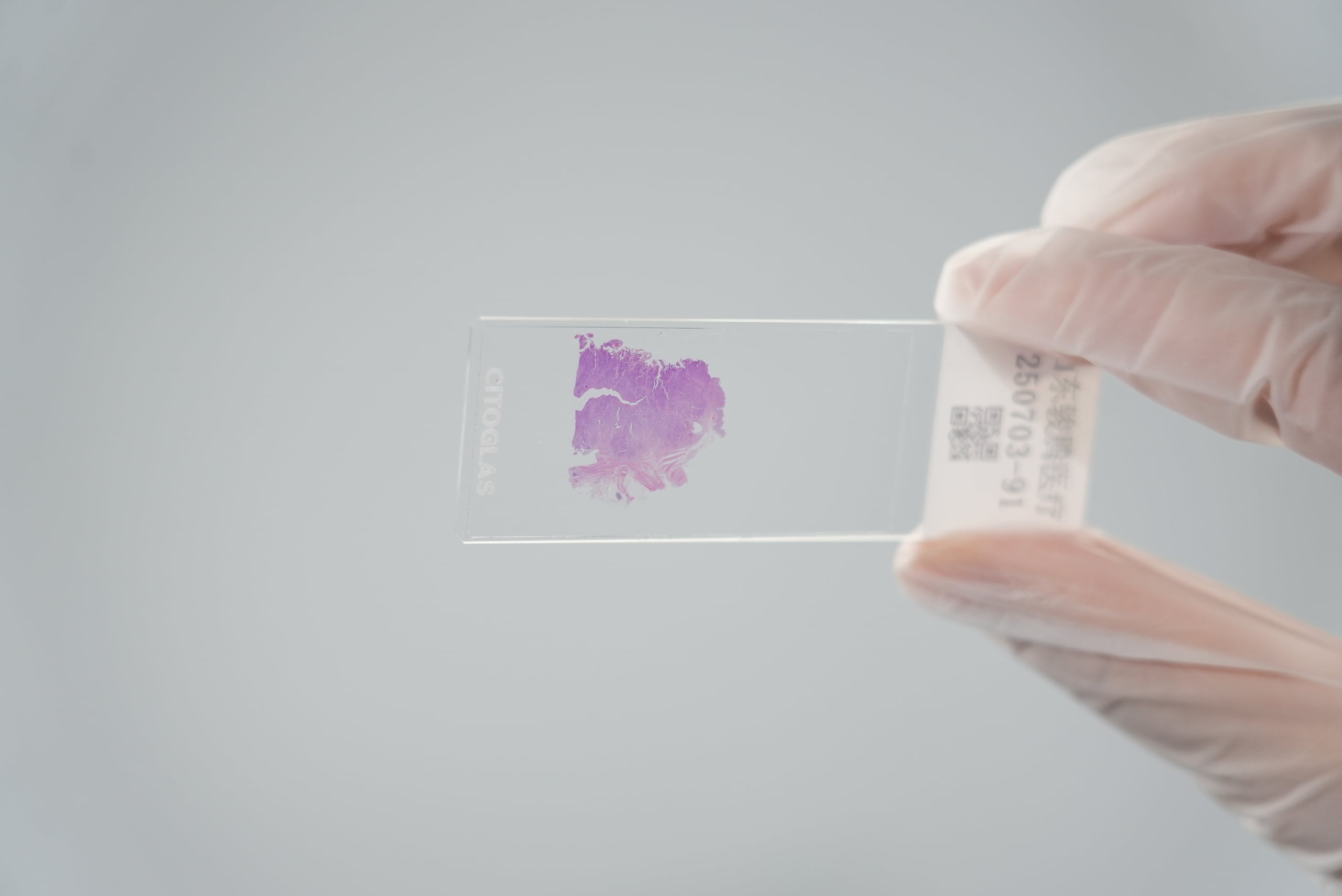
A distributor friend called me last week. His three biggest accounts — 800-bed, 1,000-bed, and 1,200-bed hospitals — were all complaining about the same thing. Not the equipment. Not the price. The coverslips.
One lab manager sent him a photo of thirty glass slides that had welded themselves into a single stack because the mounting medium had overflowed and cured overnight. The scanner that read them threw errors on every run. Another lab's techs were complaining about the xylene smell lingering in the room four hours after a coverslipping batch. The third had a tech with a paper cut on her finger from a cracked coverslip — and a biohazard form to file.
"I've installed and serviced glass coverslippers for years," my friend said. "And I've never heard this much pushback at once."
I've heard the same complaints from techs and lab managers on every continent. I troubleshoot them on site, I read the literature, and I know which fixes work and which ones are wishful thinking. So this isn't a sales pitch for anything. It's the troubleshooting list I give every lab manager who calls me about glass slide coverslipping problems. Six problems, six sections, the root causes I see most often, and the fixes that actually work — including, at the end of each one, what you'd do if you wanted to stop treating the symptom and fix the underlying cause.
These are the same six complaints I hear in any busy histopathology device lab running glass slide coverslipping at scale. They aren't rare. They aren't vendor-specific. They're the physics and chemistry of a wet-process coverslipping method operating at the throughput a modern pathology lab actually needs. Let me walk you through them.
After we go through the six, I'll tell you what I now recommend when a lab asks me what to do next. By then, you won't be surprised.
The Six Glass Coverslip Problems I See in Every Busy Lab
1. Mounting medium overflow
This is the one that ruins everybody's day. The medium dispenses across the slide, a glass coverslip drops on top, and excess medium squeezes out around the edges — onto the stage, onto the next slide, onto the transport arms of a whole-slide scanner. The result is slides that stick together, a stage that has to be cleaned between batches, and a scanner that errors out because the medium has contaminated the optics or the gripper.
Why it happens. The default dispense volume is often wrong for the actual coverslip size being used. Twenty-four by fifty millimetre coverslips need different volumes than twenty-four by forty. Slide flatness matters: even a small bow in the slide pushes medium sideways as the coverslip seats. Medium viscosity drops in warm labs and rises in cool ones, so the same volume can under-fill in January and overflow in July. And not every operator cleans the nozzle — dried medium at the tip throws off calibration within a day or two.
What I see in the field. I've been on overflow service calls in labs running 200 slides a day and labs running 2,000. The failure pattern is the same: the dispense volume that worked last quarter starts producing a thin halo of medium around the coverslip, and within a week the halo is thick enough to glue adjacent slides together in the output rack. Operators don't notice it because the slide itself looks fine to the naked eye. The scanner notices it. The next morning's error log is what brings the call to me.
What I'd try first. Calibrate the dispense volume against the coverslip you actually use (most service engineers can do this in twenty minutes). Keep the lab between 20 and 25 °C, and let the medium reach room temperature before loading it. Wipe the nozzle with xylene at the start of every shift. Switch to a higher-viscosity medium if the problem is chronic — Entellan new and DPX hold their shape better than the cheaper general-purpose mediums.
If you want to stop fighting it. The reason overflow exists at all is that glass coverslipping is a wet process. A polymer-based coverslipping film is a dry process. The film goes down flat, no liquid, no squeeze-out, nothing to overflow. If your scanner is throwing medium-related errors twice a week, the cheapest fix is a different coverslipping method.
2. Glass fragments
Cracked coverslips show up in three places: stuck in the dispenser, dropped on the bench, or — worst case — in a tech's finger. The biohazard exposure is the part that gets a lab director's attention, but the daily annoyance is the downtime. Every time a coverslip breaks, someone stops the run, clears the mechanism, and starts over.
Why it happens. Coverslips aren't all the same. The thickness spec is 0.13 to 0.17 mm, and coverslips outside that range are more brittle. Humidity warps the edges over time — a half-open box left by the bench is enough. The gripper mechanism on the coverslipper wears out faster than the service schedule suggests: I've seen nozzles that should be replaced at 10,000 slides still in service at 30,000, and the misalignment is what cracks the coverslips. Storage matters: coverslips stored near a window or in a humid storeroom absorb moisture and become fragile.
What I see in the field. The most common fragmentation call I get is from a tech who reaches into the output rack to retrieve a finished slide and feels a sharp edge. The coverslip is cracked but still in place, hiding a sliver that's been waiting for skin. The second most common is a service engineer opening up the dispenser to find five or six broken coverslips jammed where the pickup head meets the tray. Both come back to the same root cause: a spec drift between the coverslips the machine was set up for and the coverslips the lab is actually loading.
What I'd try first. Pick one supplier and stick with it. Mixed batches of coverslips with the same nominal size but different actual dimensions are the most common cause of intermittent breakage. Store the boxes sealed until use, and rotate stock. Replace the gripper nozzles on a real schedule — every 6 months or every 10,000 slides, whichever comes first. Train techs to wear nitrile gloves when handling coverslips: paper cuts from coverslips are the most common lab-acquired injury in histology, and the biohazard paperwork alone is enough reason to insist on it.
If you want to stop fighting it. Polymer-based coverslipping film is, by definition, not glass. It doesn't crack, it doesn't shatter, and it doesn't end up in a tech's finger. A dropped slide with film coverslipping is just a slide with a flexible film over it — the film bends, the glass doesn't, and the tissue stays intact.
3. Image clarity issues
This is the one that quietly costs a lab the most. The slide looks fine to the naked eye. Under the microscope, or worse, on a whole-slide scan, the field is hazy, the cell borders are soft, and the pathologist is spending extra seconds on every slide trying to read what should be obvious.
Why it happens. Mismatched refractive index is the usual suspect. Glass and standard mounting medium both sit around nD = 1.52, but a low-quality medium can drift to 1.48 or 1.55 — and at high magnification, the difference is visible. Air bubbles trapped under the coverslip scatter light. Xylene residue from incomplete clearing leaves a faint haze. And a coverslip that's even slightly tilted introduces focal drift that shows up on the scanner as out-of-focus tiles at one edge of the slide.
What I see in the field. The hardest clarity call to diagnose is the one that shows up on the scanner but not under the microscope. The pathologist looks at a few slides at the multi-headed scope and pronounces them fine. The scan comes back with a haze across the tissue area that the AI flags as low-confidence. By the time the lab calls me, they've already re-stained twice. The cause is almost always the medium, not the stain.
What I'd try first. Use fresh medium. Most mounting mediums have a working life of three to six months after opening; beyond that, they absorb moisture and the refractive index drifts. Vacuum-degas the medium before loading it — even five minutes in a desiccator pulls out the microbubbles that turn into macro bubbles under the coverslip. Verify that the clearing step in your staining protocol is actually removing the paraffin completely. And if the scanners are flagging tiles on one side of the slide, check the coverslipper's pressure foot for wear.
If you want to stop fighting it. A high-transmittance polymer film with anti-reflection coating sidesteps the entire refractive-index matching problem. The film is the same thickness every time, sits flat every time, and doesn't trap bubbles because there's no liquid to trap them in. Labs that have moved from glass to film coverslipping consistently report fewer scanner flag-outs and faster pathologist reads — the same slides, just cleaner.
4. Slow drying
The slide is covered, the run is done, and the tech has to wait. Sometimes five minutes, sometimes thirty, sometimes longer if the lab is cold or humid. During that wait, the slide can't be scanned, can't be filed, can't be moved without risking a slip. The bottleneck isn't the coverslipper — it's the curing.
Why it happens. Most mounting mediums need a solvent to evaporate before they're solid. In a typical histology lab at 22 °C and 40% relative humidity, that takes 10 to 20 minutes for a fast-drying medium and up to an hour for a slow one. Drop the temperature to 18 °C, or push humidity above 60%, and the time doubles. The coverslip itself can hold the medium in a thin film that cures from the edges inward, which is why slides stored face-down dry faster than slides stored face-up.
What I see in the field. I've walked into labs where the output rack sits next to a small desk fan pointed at the slides. That's someone's homemade drying accelerator, and it works — until it blows dust onto a wet coverslip. The more common workaround I see is a 37 °C warming plate, which is fine for fast-curing mediums but ruins slow-curing ones by trapping solvent under the coverslip and hazing the surface. The real fix is choosing the right medium in the first place, not engineering around the wrong one.
What I'd try first. Switch to a fast-curing medium if you haven't already. Entellan new, DPX, and a few of the modern synthetic mediums are designed to set in under 10 minutes at room temperature. Keep the lab climate stable: aim for 20 to 25 °C and 30 to 50% relative humidity, and put the coverslipper away from HVAC vents that blow cold air across the bench. For urgent cases, a 37 °C warming plate for five minutes will set most fast-curing mediums without boiling the solvent — but don't push it to 60 °C, that's where bubbles start.
If you want to stop fighting it. Polymer-based coverslipping film is dry-applied. The film adheres on contact — no solvent, no evaporation, no waiting. A slide coming out of a film coverslipper can be scanned or filed immediately. For labs running tight turnaround times — and these days, who isn't — that waiting time disappears from the workflow entirely.
5. Low throughput
The coverslipper is the slowest step in the line. A Leica CV5030, to pick a common example, runs at around 400 slides per hour under ideal conditions. For a lab pushing 600 slides a day through H&E, that's an hour and a half of coverslipping time — and that's before the drying wait. Add the drying wait and you're looking at most of the morning tied up at the coverslipper.
Why it happens. It's not a flaw in the machine; it's the physics of the process. Every slide needs a coverslip placed on it, and every coverslip needs the medium to set. There's no shortcut that doesn't compromise the slide. You can run two coverslippers in parallel — and many busy labs do — but that doubles the bench space, the maintenance, and the medium consumption.
What I see in the field. The labs that complain about coverslipper throughput are usually the ones that grew — a 200-slides-a-day lab that became a 1,000-slides-a-day lab without anyone re-evaluating the coverslipping step. The coverslipper is the last thing people upgrade, because it's been "fine" for years. It was fine at 200. It's the bottleneck at 1,000, and the stainer upstream is being paid for in time you're not using.
What I'd try first. Run the coverslipper in batch mode and stack the output for the drying wait so the operator can be doing something else. Pre-warm the medium. Make sure the gripper and dispense nozzle are clean — a partial blockage is the most common cause of an unexpected throughput drop. And if the bottleneck is really the coverslipper, look at the upstream staining step: if the stainer is faster than the coverslipper, you're spending capital on stainer time you're not using.
If you want to stop fighting it. Film coverslippers run at 1,000 slides per hour or higher — and there's no drying wait, so the effective throughput is exactly what the spec sheet says. For a lab pushing 1,000 slides a day, that's a one-hour coverslipping block instead of three, with no drying curve to manage afterwards. If your coverslipper is your bottleneck, the math makes the decision for you.
6. Xylene odor
Every histology lab has it: that solvent smell that hits you the moment you walk in. Techs get used to it. New staff complain. The occupational health paperwork is never fun. And in some jurisdictions, the air-quality limits on xylene are tight enough that a coverslipping bench is the most-regulated workstation in the building.
Why it happens. Glass coverslipping uses xylene in the medium and, often, in the clearing step. The coverslipping bench is where the solvent evaporates from the freshly mounted slides — and the slower the medium dries, the longer the xylene is in the air. In a busy lab running coverslipping for an hour at a stretch, the xylene concentration at the bench can hit half the occupational exposure limit on a bad day.
What I see in the field. The xylene complaint is usually the one that comes from new staff, not the veterans who've been in the lab for years. New techs notice the smell on day one. Experienced techs have stopped noticing it — but their liver function tests still register the cumulative exposure. I've seen labs that handle the smell by opening a window in summer and closing it in winter. The occupational health officer is never the one who suggests that approach.
What I'd try first. Switch to a xylene-free or low-xylene mounting medium — EcoMount, Clarion, and a few others are designed for this. Make sure the bench has local exhaust ventilation; a fume hood or a downdraft vent cuts the airborne concentration by 80% or more. Rotate staff so no single tech spends the whole day at the coverslipper. And run the coverslipper in batched bursts rather than continuous operation — it gives the room time to clear between runs.
If you want to stop fighting it. Polymer-based coverslipping film uses xylene as an activator — the solvent touches the film, the film adheres, and within seconds the slide is dry. The xylene is still there, but the exposure window is measured in seconds rather than the 10 to 60 minutes of a glass coverslip drying on the bench. Labs that have switched to film coverslipping consistently report a noticeable drop in coverslipping-area xylene readings, and a corresponding drop in the smell that greets you at the door.
So that's the six. Six problems, six sets of fixes, six places where the same answer keeps coming up: the wet, slow, glass-based coverslipping process is the underlying cause, and every fix is a way to make a wet process behave like a dry one.
If your lab has tried the fixes above and you're still losing time to overflow, fragments, hazy scans, drying waits, throughput limits, or xylene exposure, the next conversation isn't about adjusting the coverslipper. It's about whether to keep using glass at all.
Before that conversation, though, a word on when to keep troubleshooting and when to stop. Glass coverslipping still earns its place in some workflows, and a tech who knows which fixes to apply can keep a glass line running productively for years. The signal that it's time to stop troubleshooting isn't any single one of the six problems above. It's the pattern: when the same lab is calling me back every quarter for the same overflow issue, or when the scanner-error log is longer than the run log, or when the xylene monitor hits the action level twice in a month, the bottleneck isn't the coverslipper. It's the choice of coverslipping method. At that point, every fix on this list is a Band-Aid on a problem that has a structural solution.
The decision tree I walk labs through is short. If your daily volume is under 200 slides, your scanner is gathering dust, your turnaround time isn't measured in hours, and your techs have been on the same coverslipper for a decade — keep the glass, run the checklist above, replace the consumables on schedule, and you'll be fine. If any one of those isn't true, the conversation shifts. If two or more aren't true, the conversation is already over — you're just doing the work of admitting it.
One last note on the troubleshooting that doesn't work, because I get asked about these all the time. Switching to a "premium" mounting medium rarely fixes overflow if the dispense volume is wrong — you're spending more on the medium to mask a calibration problem. Adding a HEPA filter to the lab doesn't help with xylene at the coverslipping bench, because the xylene is being released right at the source, not drifting in from the hallway. Upgrading to a thicker coverslip to "reduce breakage" usually increases breakage, because thicker glass is more brittle under the gripper. And no software update, service contract, or operator training is going to make a wet process behave like a dry one. If you've tried two or three of the legitimate fixes above and the problem keeps coming back, the issue is the process, not the parameters.
Why Many Labs Are Moving to Film Coverslipping — and What to Look For
I'll be straight with you: film coverslipping isn't perfect for every lab, and the people who tell you it is are selling you something. But for a specific profile of lab — high throughput, digital pathology workflow, AI-assisted reading, tight turnaround times — it solves problems that glass coverslipping can't, only manage.
The HT-BSHE-660 stainer and HT-FilmC-1000 coverslipper are an integrated workstation we've built for exactly that profile. The stainer runs 660 slides per hour with 12 simultaneous staining protocols, 6 configurable stations, and a reagent tank capacity that handles a full day's run without a refill. The coverslipper runs 1,000 slides per hour — that's two and a half times a typical glass coverslipper — with an output storage of 240 slides so the operator doesn't have to babysit the run. The patented ASBT staining algorithm adjusts protocol timing in real time based on slide count and reagent age, so the first slide of the run and the last slide of the run come out the same. RFID tracks every reagent, every fill, every cycle. From dewaxing to coverslipping, the whole line is hands-off.
The film itself is a polyester tape with high transmittance and anti-reflection coating. It goes down flat, every time, with no liquid to overflow, no bubbles to trap, no fragments to clean up. The machine adjusts the tape length intelligently for each slide. And because there's no drying wait, the slide coming out of the coverslipper is a slide you can immediately scan, file, or send to the pathologist.
For labs already running whole-slide scanning and AI-assisted reads, the workflow gains are the ones I hear about most: fewer scanner errors from coverslipping contamination, more consistent slide prep for the AI to read, faster turnaround because the drying wait is gone. For labs still on glass, the comparison is the six problems above — every one of them goes away or shrinks significantly when you stop using a wet process to do a job a dry process does better.
On the credentials side, the workstation is built by an IVD device manufacturer — Shandong JunTeng Medical Technology, established 2015, national high-tech enterprise, ISO 9001 and ISO 13485 at the company level, with CE compliance on selected products. The R&D team is 60-plus doctoral and master's degree engineers, the IP portfolio sits at 100-plus rights including 21 invention patents, and the production base is 22,000 square metres. We service 660-plus hospitals across 30 Chinese provinces. None of that matters if the workstation doesn't perform in your lab — but for tender submissions and distributor agreements, it's the documentation your procurement team is going to ask for.
One thing worth saying directly: this isn't the only film coverslipping workstation on the market. Leica has been the reference in glass coverslipping for decades, Sakura has been the reference in film coverslipping, and other manufacturers are catching up. We're not going to tell you those machines are bad instruments — they aren't. What we offer is a comparable workflow — integrated H&E staining at 660 slides per hour, integrated film coverslipping at 1,000 slides per hour, full automation from dewaxing through coverslipping — at a price point, a consumables model, and a partner relationship that imported equipment doesn't match. For a distributor, that's the difference between a catalog line and a business you can actually build.here.
For distributors and tender agents, the workflow story is part of the pitch, but the commercial story is what closes deals. Two things matter here.
The first is consumables. Glass coverslipping ends your revenue the day the machine is installed — the lab buys its own coverslips and medium from whoever quotes lowest. Film coverslipping doesn't. The coverslipping film used on automated film coverslippers is a medical consumable made by a small group of manufacturers, and labs order the tape from whoever placed the machine, every month, for the life of the install. That's recurring revenue tied to the equipment you sold. And because we manufacture the HT-Tape coverslipping film in-house — 70 m per roll, 24 mm width, high-transmittance polymer — it's available to our partners at a price point and lead time that imported film can't match.
The second is the install base you don't own yet. JunTeng HT-Tape is manufactured to the same roll format and activation specification as the film used on Sakura film coverslippers. That means it works as a direct replacement on Sakura machines already installed in the field — at a lower price, with a shorter lead time. For a distributor with no relationship to a Sakura account, the way in is the tape. Sell the tape, earn the trust, and the workstation conversation follows. Machines are sold once. Tape is sold for the life of every machine you can reach — including the ones somebody else placed.
Reference: Tissue-Tek Film® Automated Coverslipper.
Why Choose JunTeng Film Coverslipping Over Sakura's Film Coverslipper?
Questions Distributors Ask Me About the Switch
"Can a tech still go back to glass if they need to?"
Yes, and many labs keep a glass coverslipper as a backup for special stains or low-volume work. The integrated workstation doesn't lock you out of any workflow — it just makes film coverslipping the default for routine H&E.
"How do I convince a lab manager who's been on glass for twenty years?"
Don't start with the technology. Start with the bottleneck. Ask them what their slowest step is. Ask them how many scanner errors they had last month. Ask them what their xylene monitoring showed. The case for film coverslipping is in their own data; you just have to point at it.
"Does JunTeng HT-Tape actually work on Sakura machines?"
Yes. The roll format, width, and xylene-activated adhesive are compatible with the major film coverslipper platforms. We have distributor partners running HT-Tape on installs where the original equipment brand is a competitor. It's one of the easier conversations in the business.
"What about tenders — can you supply the technical files we need?"
Yes. ISO 9001 and ISO 13485 at the company level; CE compliance on selected products. Full spec sheets, declaration of conformity, and technical response documents are available for tender submissions.
"Can you private-label the workstation or the tape?"
Yes. OEM and ODM arrangements are part of how we work with regional partners. Brand, packaging, and software language can all be configured to your market.
HT-BSHE-660 & HT-FilmC-1000 product page.
What I'd Do If I Were You Tomorrow
Back to that distributor friend and his three hospital accounts. After we went through the six problems, I asked him what he was going to do. He said he was going to send each lab manager a sample roll of HT-Tape and the spec sheet for the integrated workstation, and let them run their own comparison. The lab with the scanner errors would be the first call.
That's the same advice I give anyone reading this. The troubleshooting list above will keep your glass coverslipper running. If you're spending more time on it than you want to, the next step isn't another round of adjustments. It's a side-by-side trial of the alternative — and the most useful thing you can do is put a roll of compatible coverslipping film in a tech's hand and let them run the comparison themselves.HT-Tape coverslipping film product page.
If you want the spec sheet, a sample roll of HT-Tape, or the distributor kit for your region, send me a note. We ship sample rolls, full technical documentation, and tender support packages to qualified partners — and we answer our own email.
You can get the full specification sheet and the distributor kit here