
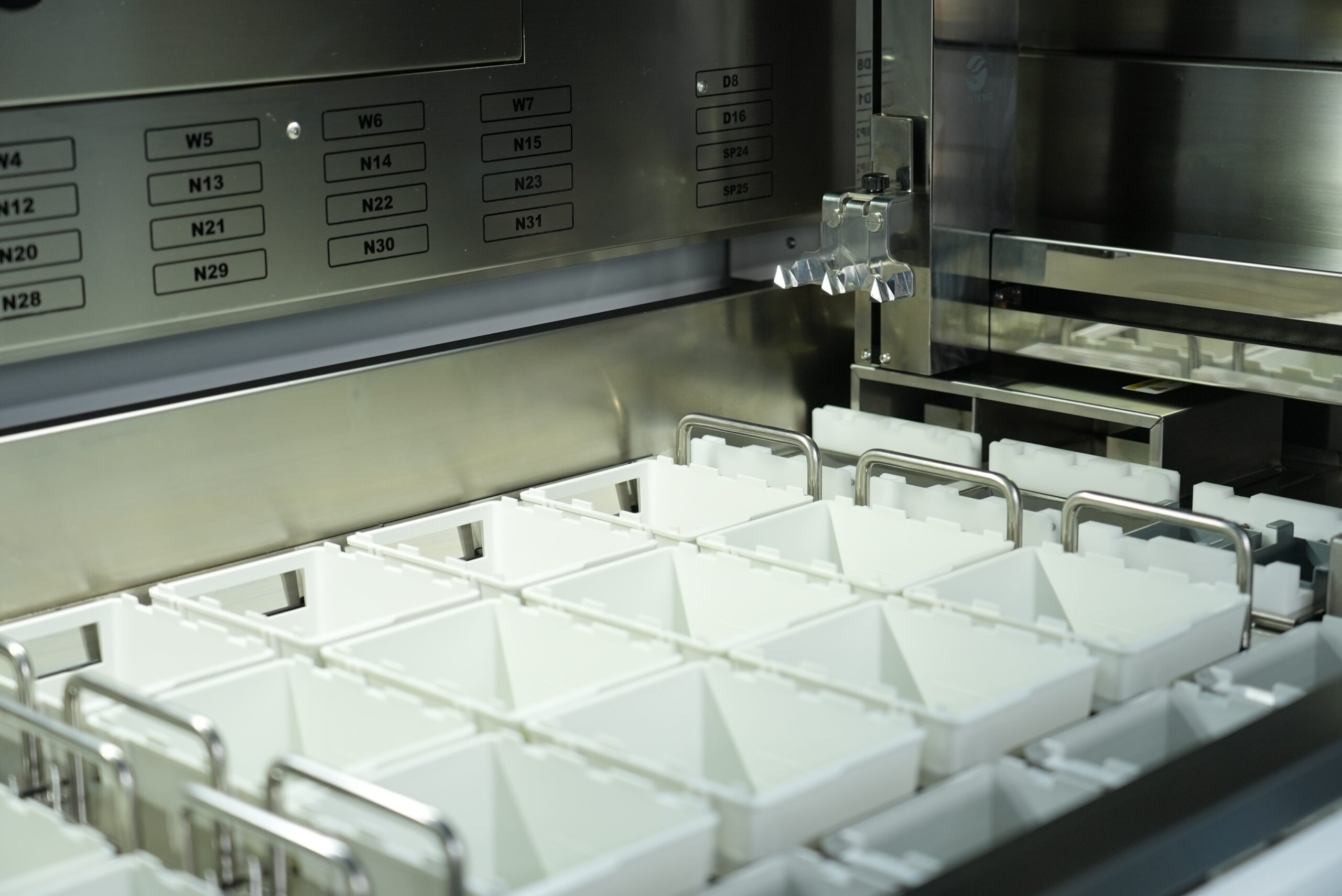
I used to write "humidity" on a service report the way a tired doctor writes "stress" — a polite shrug when I couldn't pin down the real cause. That stopped the day I pulled the side panel off a stainer in a coastal lab and found green fur on the motherboard.
Not dust. Not dried reagent. Living mold, tracing the copper lines between the controller and the power supply, feeding on condensation that never dried because the AC had been off since Friday. The board was four years old and dead. The stainer had been resetting mid-run for two weeks, and the lab had been blaming the software.
I've spent over ten years installing and repairing histology equipment from most of the major international brands. In temperate zones, humidity is a footnote. In tropical markets — Southeast Asia, West Africa, the Pacific coast of Latin America — it is the number one reason equipment dies early. It hits three things first: electronics, optics, and the coverslipping step.
H&E staining follows the same protocol whether you use glass or film. The hematoxylin and eosin go on the same way. The split happens at the coverslipping step — and that's where humidity bites hardest, because film adhesion depends on a warm, dry slide surface that tropical air refuses to give you. But the diagnosis and the fix are different for each part of the system, so let me walk through them in order.
What Humidity Does to Electronics
Green Fur on the Board
Symptom: The stainer resets mid-run. Random error codes that don't repeat. The machine runs fine for hours, then crashes during a batch, and the error log shows nothing useful.
How to judge: Kill the power. Remove the side panel — usually four screws. Shine a flashlight on the mainboard. You're looking for greenish or white fuzz along the copper traces, near connectors and the power supply. If you see it, don't touch it. That fuzz is conductive when damp, and it's why your machine resets.
Root cause: Above roughly 70 percent relative humidity, condensation forms on any surface colder than the dew point. Circuit boards in machines that run warm during the day and cool overnight collect moisture in a thin film. That film absorbs lab vapors — xylene, alcohol, formalin — and becomes mildly conductive. Mold grows. Traces corrode. The board develops intermittent shorts that disappear when the machine warms up, which is why errors are random and impossible to reproduce on a service visit.
What to try first: Kill the power, let the board dry — a fan on low, two hours minimum. Clean the affected traces with 99 percent isopropyl and a soft brush. But the real fix is prevention: keep humidity below 60 percent and leave the machine on standby overnight. I've seen this on a slide stainer from a well-known brand, and on cassette printers from another. The principle is the same.
Pump Seals That Go Soft
Symptom: Reagent drips from tube connections you've tightened three times. Pump pressure is inconsistent. The machine reports a pumping error on station four, but the pump sounds normal.
How to judge: Run your finger along tubing joints and push-fit connectors. If they feel tacky or swollen, humidity has got to the rubber. Squeeze an O-ring. If it doesn't spring back, it's dead.
Root cause: Rubber and elastomer compounds absorb moisture. Combined with heat, they age fast, losing elasticity and swelling. A pump that held fine at 40 percent RH starts weeping at 80 percent because the O-rings have softened enough to leak under pressure. By the time you see a drip, the seal has been degrading for weeks.
What to try first: Replace the O-rings. Use silicone rather than nitrile if you have the option. Check the pump pressure log if the machine keeps one — if pressure has drifted down over weeks, the seals are the suspect, not the pump motor.
What Humidity Does to Optics
The Cloudy Scope
Symptom: Slides look hazy under the scope. Not the stain — the background looks milky. You change slides, same haze. You blame the stainer, but the chemistry is fine.
How to judge: Take a brand-new blank slide. Put it on the scope stage. If the blank looks cloudy too, the problem is the optics, not the staining. Look at the condenser lens — if you see a mist or dull film, that's condensation. The lens is below the room's dew point.
Root cause: Any optical surface colder than the air will fog. Microscopes near windows, or in rooms where the AC cycles on and off, develop condensation on the condenser and objective lenses. The haze is worse in the morning when the scope is cold from the overnight shutdown, and fades as it warms up — which is why nobody reports it until Monday morning.
What to try first: Let the scope warm up 15 minutes before use. If the haze persists, check whether the AC vent is aimed at the scope. Store it in a desiccator cabinet or a sealed bag with silica gel overnight. The fix is environmental.
What Humidity Does to Film Coverslipping
Film That Won't Stick
Symptom: The film coverslipper produces slides where the film lifts at the edges, bubbles form underneath, or the film looks wrinkled. The same batch worked fine last week. Nothing changed except the weather.
How to judge: Pull a slide from the output and look at it at a low angle. If the film is lifting or bubbling, the adhesive didn't bond. Now check the slide surface before it enters the coverslipper — if you see residual solvent, xylene hasn't evaporated, and the adhesive can't grab a wet surface.
Root cause: Automatic film coverslipping uses a polyester tape with a cellulose adhesive that activates in xylene and needs a warm, dry slide surface to bond. In high humidity, two things go wrong. First, xylene evaporation slows because the air is saturated, leaving a microfilm of solvent that blocks adhesion. Second, the adhesive layer absorbs moisture from the air, reducing tackiness. Temperature matters too — if the room is too hot, the film wrinkles or the adhesive softens before it sets. Either way, the symptom is the same: lifting edges, bubbles, wrinkles. This is the key difference from glass coverslipping, where liquid mounting medium can self-level. Film can't.
What to try first: Increase the drying station temperature a few degrees to speed up xylene evaporation. Make sure the slide is completely clear before it enters the coverslipper. Buy a cheap hygrometer and check the room's RH at the time the bad slides are produced. If it reads above 65 percent, you need a dehumidifier in the coverslipping area, not a new batch of film. I've replaced good film rolls for customers who swore they had a defective batch, when the lab was at 80 percent RH and nobody had checked.
What Humidity Does to Reagents
The Mystery of Rising Water Levels
Symptom: H&E staining intensity varies day to day. Blues look washed out. The protocol that gave crisp nuclear staining last week looks pale this week. Reagents are from the same lot.
How to judge: Look at the water rinse stations. Mark the level in the morning. Check it in the afternoon. If the level has risen and nobody topped it up, moisture is condensing into the reagent overnight. Do the same with the bluing.
Root cause: Water-based reagents — bluing, tap water rinses, buffers — are open to the air. In a humid lab, water condenses into these stations overnight. The reagent dilutes slowly. Over a week, concentration drifts enough to affect staining. It's a slow fade nobody notices until the QC slide looks wrong, and by then the reagent has been off-spec for days.
What to try first: Cover the reagent stations when the machine is idle. If you have a machine with sealed reagent management, use it. In humid climates, replace water-based reagents more often than the standard schedule suggests.
What Humidity Does to Archived Slides
Slides That Cloud in Storage
Symptom: Slides look perfect when they come off the staining and coverslipping line. A week later, they're cloudy. Some have what looks like growth under the film or coverslip.
How to judge: Check where the slide cabinet is. If it's against an exterior wall, near a window, or in a room where the AC turns off overnight, temperature cycling causes condensation inside the cabinet. Moisture gets under the film or coverslip, and in a tropical climate, growth follows within days.
Root cause: Slides archived in humid air develop condensation under the coverslip or film when temperature cycles between day and night. The moisture feeds mold and bacteria. This is a storage problem, not a staining problem — but the customer will blame the staining, because that's what they can see.
What to try first: Move slide storage to an interior room with stable temperature. Add desiccant packs. If the AC turns off overnight, fix that first — humidity spikes the moment the AC dies.
Before You Install: An Environmental Checklist
If you're a distributor in a tropical market, walk the lab before the machine arrives. Here's what I check:
| Item | Target | Red Flag |
|---|---|---|
| Room relative humidity | 30–60%, ideally 40–50% | Above 70% — needs dehumidifier |
| AC schedule | 24/7 operation | Off overnight — humidity spikes |
| Wall placement | Interior wall | Exterior wall — temperature cycling |
| Window proximity | No windows near equipment | Window = humidity swings |
| Power reliability | Stable, no brownouts | Brownouts kill AC → humidity spike |
| Slide storage | Interior room, stable temp | Near window or exterior wall |
The CLSI guidelines list temperature stability and humidity control as a baseline requirement. If your customer's lab doesn't meet these basics, you'll get the service call eventually — and it won't be the machine's fault.
The WHO laboratory guidance makes the same point: environmental infrastructure comes before equipment, not after.
What I Look For in Equipment Headed for Humid Markets
Everything I just described — the mold, the fog, the lifting film, the diluted reagents, the soft seals — these are failure modes I've seen across brands. Some of them on machines from a well-known brand that costs three times what ours does. The difference isn't the price tag. It's what the manufacturer tested for before the machine left the factory.
Our automated coverslipping & staining workstation pairs the HT-FilmC-1000 coverslipper with the HT-BSHE-660 stainer. The HT-FilmC-1000 uses a polyester tape whose high-performance cellulose adhesive activates in xylene, eliminating glass coverslips and liquid mounting medium entirely. That matters in humidity because there's no liquid mountant to evaporate — the bond forms during the clearing step, not through a solvent that needs dry air to flash off. The fast-drying film eliminates adhesive overflow, which in my experience is the symptom most commonly confused with true humidity-related bonding failure. When a customer says "the film isn't sticking," the first thing I separate is overflow from adhesion failure — and this design takes overflow out of the equation.
The HT-BSHE-660 runs as a self-contained workstation — dewaxing, hydration, staining, rinsing, dehydration, and clearing in one enclosed path. That enclosure limits the reagent's exposure to ambient air, which is the specific mechanism by which humidity dilutes open reagent stations. The intelligent reagent management system tracks reagent age and slide count, adjusting staining parameters in real time. If humidity is slowly diluting a reagent, the system flags it for replacement before the QC slide goes bad.
For H&E staining & coverslipping, the polyester tape gives better optical clarity than traditional glass coverslips, with anti-reflective properties for digital pathology. In humid climates where every glass surface is a condensation target, having one fewer glass surface in the optical path is a real advantage.
The cloud platform on the HT-FilmC-1000 monitors and uploads device status remotely. I wish I had that tool ten years ago — it would have saved me flights to labs where the diagnosis was "your AC turns off at night."
For the upstream side, the same principles apply to our tissue processors: sealed reagent systems and remote monitoring. In a lab at 80 percent RH, you want machines that track their own conditions and tell you when something is drifting, because the customer won't notice until the slide is already wrong.
Questions Distributors Ask Me About Humid Climates
"My customer is in Manila. What do I tell them before installation?"
Get a hygrometer. If the room reads above 65 percent RH during the day, they need a dehumidifier before the machine arrives, not after. Don't install and hope.
"Slides are fine in the morning but bad by afternoon. Is that humidity?"
Probably. The AC runs in the morning when the tech arrives, then cycles off as the day warms up. By mid-afternoon, the room humidity has risen, and the coverslipping step degrades. Check the room RH at the time the bad slides are produced, not at 8 AM.
"Can automated film coverslipping handle high-humidity labs?"
Better than glass coverslipping, because the adhesive doesn't depend on solvent evaporation the way liquid mountant does. But no machine compensates for 80 percent RH indefinitely. You still need environmental control in the coverslipping area.
What I Tell Every Distributor
Humidity is the one variable no machine fights on its own. A good stainer, a good film coverslipper, a good tissue processor — they all assume the environment is controlled. When it isn't, the machine reports a fault, the customer blames the equipment, the distributor sends a service engineer on a plane, and the engineer finds mold on the motherboard.
If you're selling into tropical markets, do the environmental assessment before the contract is signed. It's cheaper than a service call, and it's the one thing that separates a customer who recommends you from one who files a warranty claim.