
I was leaning against a carousel tissue processor in a 400-bed hospital's prep room, listening to it click through its cycle, when the lab manager walked in and asked the question I hear more often than you'd think: "Everyone says retort is the future. Are they right, or are they just selling me something?"
It's a fair question. I've spent years installing, running, and — when things go wrong — taking apart automated tissue processors. I've worked with carousel units and retort flagships from Leica and Sakura. I've seen both produce excellent slides, and I've seen labs pay for features they never once used. What follows is the same walkthrough I give anyone who asks. No brochure talk. Two questions, the numbers, and what I'd actually do if the machine were going into my own lab.
Because a tissue processor is the quietest bottleneck in a pathology lab. When it works, nobody notices. When it doesn't, the whole morning's biopsies sit in formalin waiting. Choosing one shouldn't be a brand exercise — it should be a decision about how your lab runs for the next ten years.
Why Choose a Retort Tissue Processor Over a Carousel Model?
First, let's be precise about how the two actually work, because there's a lot of confusion out there — including in some marketing material.
A carousel processor is the workhorse most labs grew up with. The tissue sits in a basket, and the basket moves from reagent station to station — alcohol, xylene, paraffin, in sequence. Depending on the model, those stations may be covered, ventilated, or semi-enclosed, but the defining feature is the same: the basket travels between reagents. It's proven, it's reliable, and it processes a lot of cassettes without drama. That's why most of the installed base still runs carousels.
A retort processor takes the opposite approach: it keeps the tissue in one sealed chamber and moves the reagents instead. Reagents are pumped in and out under controlled pressure and vacuum, with active agitation along the way. Same reagents, same end result — but the way reagent reaches the tissue is different, and that difference drives most of what matters downstream.
Tissue quality. Here's where I have to be careful not to oversell. Fatty or larger specimens are harder to process consistently — and the reasons are usually a combination of fixation, specimen thickness, dehydration, clearing, and protocol design, not one factor alone. What a retort gives you is more control over the processing conditions: pressure, vacuum, temperature, and agitation are all parameters you set inside one chamber. More control doesn't automatically mean better slides; it means you have more dials to turn when a specimen type isn't coming out right.
Reagent management. A carousel holds a fixed volume in every station, and the basket carries reagent from one station to the next as it transfers. A retort meters reagent through the chamber by the cycle. Modern retort processors can provide more controlled reagent management — and depending on your workload, your protocol, and your reagent-management strategy, that may improve how efficiently you use reagents. I won't promise you that a retort always uses less reagent than a carousel, because that depends on how you run it. But the control is there if you want to track it.
Protocol flexibility. Because a retort can combine pressure, vacuum, temperature, and agitation inside one sealed chamber, it generally gives you greater flexibility for accelerated protocols. I'm not saying retort processors are always faster — some carousel models also offer vacuum, basket rotation, or agitation. But if you want to compress a timeline on a difficult case, a closed-retort system gives you more parameters to work with.
Overnight runs. I'd rather frame this as what to look for, not as a blanket claim. On any modern retort processor, a buyer should ask: does it run a self-check before each cycle? Does it monitor liquid levels so samples don't dry out? Does it track temperature and pressure in real time? Does it alarm? And if power fails mid-run, does it remember where it was and resume? On the HT-AP series specifically, the answer to the self-check, liquid-level sensing, real-time tracking, and power-resume questions is yes — but that's a spec you verify on whatever you buy, not something you assume.
Sure, a carousel costs less on the invoice, and for a lot of labs that's the right call. A carousel may still make sense when your workload is mainly routine, overnight processing is sufficient, budget is a major consideration, your staff already know the workflow, simpler local maintenance matters, or you need a backup processor. I'm not here to tell you retort is better in every scenario — it isn't. But for laboratories that need higher throughput, greater protocol flexibility, or more controlled processing conditions, closed-retort systems are often the more practical long-term choice.
| Retort | Carousel | |
|---|---|---|
| Tissue / reagent movement | Tissue stays; reagents pumped in/out | Basket moves between reagent stations |
| Protocol control | Pressure, vacuum, temperature, agitation | Time and temperature; some add vacuum / agitation |
| Rapid-protocol flexibility | Generally greater | Varies by model |
| Routine overnight processing | Well supported | Well supported |
| Workflow complexity | Higher | Lower |
| Maintenance considerations | Pumps, valves, fluidics, sensors | Rotating arm, basket transfer mechanism |
| Initial investment | Higher | Lower |
| Best suited for | High throughput, protocol flexibility, controlled conditions | Routine workloads, budget-sensitive labs, backup duty |
Why Choose JunTeng Over Leica, Sakura, and Dakewe?
Let me be straight about something first: I'm not going to tell you Leica or Sakura make bad instruments. They don't. Their machines are proven, their service networks are mature, and plenty of excellent labs run nothing else. If brand comfort is your priority, that's a legitimate choice.
But if you're a distributor building a product line, or a bidding agent putting together a tender, the question isn't "which brand is famous." It's "which manufacturer can I defend to a hospital committee, at a price the committee can approve, with documents that survive technical review." That's a different conversation entirely. And it's the one I have with more and more procurement people every year.
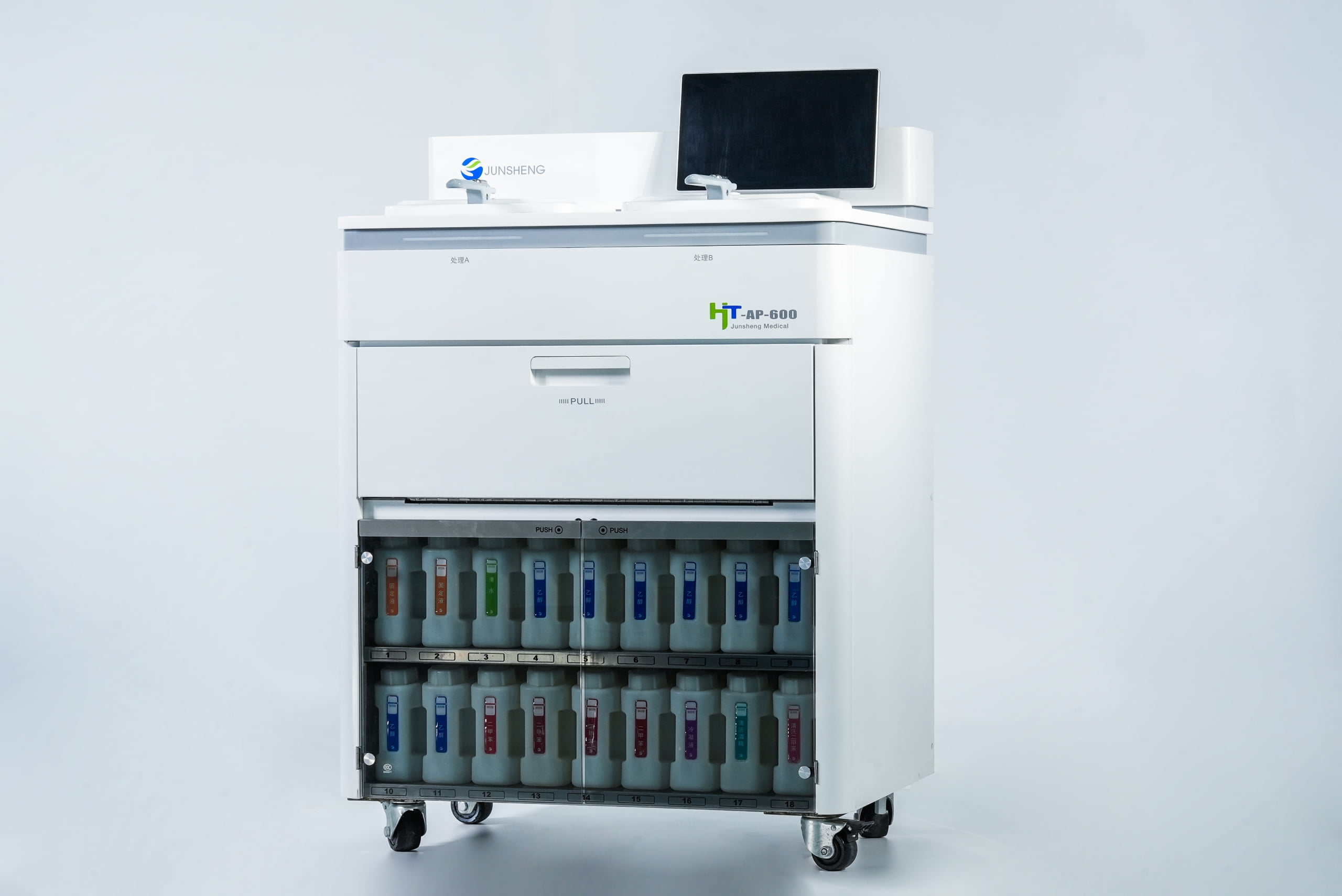
Same core technology, a different price band. The HT-AP-300 and HT-AP-600 automated tissue processors sit in the same family as the retort machines you already know — sealed reaction chamber, pressure-vacuum infiltration, active reagent mixing. That's not a marketing claim; it's the same design language the flagships use. What changes is what it costs to buy, to maintain, and to resell with a margin attached. For a distributor, that margin is the difference between a catalog line and a business.
On the engineering side, the HT-AP units mix reagents three ways — fluidics, ultrasound, and pressure & vacuum — to promote active reagent distribution and even heat. Heating runs on a PWM-plus-PID controller for rapid, controlled heating. The interface is a 15.6-inch touchscreen (13.3-inch on the HT-AP-300) available in multiple languages, with 15 validated tissue processing programs preset and room for technicians to define their own — including a delayed end time that extends certain steps over the weekend. The HT-AP-600 holds 600 cassettes; the HT-AP-300 holds 300. Power draw stays under 2,000 W, which matters when a tender specifies a clinic's existing electrical capacity.
Standard reagents, no lock-in. Let me clear up a misconception while I'm here. Many conventional tissue processors — carousel or retort — can use standard histology reagents: alcohol, xylene, paraffin. That's the norm for routine processing. Some rapid-processing platforms do use dedicated or manufacturer-specific reagent systems to achieve their validated rapid protocols — and if you're buying speed, that's a consumable cost to budget for. JunTeng's HT-AP series runs standard reagents in standard protocols. No proprietary consumables to factor into your operating budget.
Documents that survive a tender. A bid for a histopathology device lives or dies in the technical file. At the company level, JunTeng is certified under ISO 9001 and ISO 13485 quality management systems. On the product side, selected models carry CE compliance — not every model, and that distinction matters when a tender asks which specific unit meets the requirement. The spec sheet matches line by line. When the evaluation committee asks for evidence, you're not scrambling.
Scale you can build a partnership on. JunTeng was founded in February 2015 and has grown into a national high-tech enterprise with a 60-plus-person R&D team (doctoral and master's degrees), more than 100 intellectual property rights — 21 of them invention patents — and a 22,000-square-meter production base. They serve over 660 hospitals across China through a network covering 30 provinces and municipalities. That's not a workshop operation. That's a manufacturer that can hold up its end of a supply agreement.
OEM and private label without friction. If you want your own brand on the machine — and many of the most successful distributors do — JunTeng will build it. Custom branding, packaging, and software language are part of the conversation, not an exception. For a bidding agent, that flexibility can be exactly what wins a tender where the spec calls for a specific brand or a local distributor requirement.
Support that doesn't end at the port. The question I always ask a distributor is simple: who fixes it in your country? JunTeng's model covers training, spare parts, and service handover so the local partner isn't left holding a warranty they can't honor. That's the part of the brochure nobody prints, and it's usually the part that decides whether a partnership lasts.
I'm not telling you to ignore the established names. I'm telling you the gap between "established" and "right for this market" is wider than most buyers assume — and in this, as in any IVD device purchase, the technical file, the total cost, and the partner you can actually reach matter more than the logo on the front.
Questions Distributors Ask Me Before Signing a Partnership
When a distributor sits down with me — sometimes over a call, sometimes across a booth at a trade show — the questions are rarely about throughput. They're about risk. Here are the ones that come up most, with the answers I give.
"Can you provide the technical files for a tender submission?"
Yes — ISO certificates, CE documentation for eligible models, spec sheets, and the supporting paperwork a bid needs. If your tender requires specific formats or language versions, that's handled in the preparation stage, not after you've already submitted.
"What's the lead time if I order fifty units?"
JunTeng's production base is built for volume, and OEM runs are scheduled with the factory directly. I won't quote a number here because it depends on configuration and destination — but the honest answer is that capacity has never been the bottleneck in their partnerships. Ask, and you'll get a real date, not a hopeful one.
"Do you lock us into proprietary reagents?"
For routine processing, the HT-AP series runs standard histology reagents — same alcohol, xylene, and paraffin you already buy. That's consistent with how many conventional tissue processors work. If a customer later wants a rapid-processing platform that uses dedicated reagent systems, that's a different conversation and a different budget line. The point is: on the HT-AP, your customers stay free to use standard reagents.
"Who handles warranty and spare parts in my country?"
You do, with their training and support behind you. The partnership model is built so the local partner can actually service what they sell — which is exactly what your customers will ask about before they sign.
"Can you private-label for us?"
Yes, and it's routine. Branding, packaging, even software language can be customized. Plenty of distributors run JunTeng hardware under their own brand and treat it as their flagship line. You can get the full specification sheet and the distributor kit here.
If you're a bidding agent, one more piece of advice: ask for the documents before you commit to a tender, not after. A manufacturer that hesitates on paperwork will hesitate on a warranty claim too. JunTeng doesn't.
What I'd Do If I Were Buying Tomorrow
Back to that lab manager. After I walked him through all of this, he asked the one question I always like: "If it were your lab, what would you buy?"
Same thing I'd tell you. Retort technology, because the sealed chamber gives you more control over processing conditions and defensible overnight runs. And then a manufacturer I can actually reach — one with the certifications, the production scale, and the flexibility to work the way my market works. The famous names will always be there, and they're good. But "good" isn't the same as "right for you."
If you're evaluating suppliers, or you've got a tender in front of you and the technical file looks thin, email me directly and I'll send you the full spec sheet for the HT-AP-300 and HT-AP-600, plus what we can put in front of an evaluation committee. Here's where you can reach me.