
Two quotes sat on a lab manager's desk: one tissue processor 30 percent cheaper than the other. She asked me which one to sign. Instead of answering, I asked to see her filing cabinet.
I spent three afternoons in that office with ten years of paperwork — reagent purchase orders, service call reports, electricity bills, one grim invoice for a re-run of an entire week's biopsies. Then I added it up in four columns on a single sheet. The cheaper machine was not cheaper. Not over ten years. Not even close.
I've been a field service engineer for histology equipment for over a decade — installing and repairing tissue processors, stainers, coverslippers, and cassette printers from most of the big international brands. Somewhere along the way I learned that my job is only half wrenches. The other half is reading ledgers. Here is the version of that sheet I now build for any lab about to sign a purchase order, and for any distributor about to put their name on the warranty.
The Sticker Price Is a Down Payment
The first thing I tell people: the purchase order is a down payment, not the price. An automatic tissue processor that runs overnight, seven days a week, for ten years, costs money in four places after the invoice — reagents, power, downtime, and service. In my experience, the reagent line alone over ten years rivals the machine itself. The other three lines decide whether the total lands at two machines' worth or five.
Most labs never see this because nobody keeps the receipts in one place. Reagents come out of the consumables budget. The service visits come out of a different budget. The downtime doesn't get booked anywhere — it just shows up as overtime, delayed reports, and one very unhappy surgeon. So the ledger I'm about to walk you through is not accounting. It's detective work.
The problem is structural. When a tender committee evaluates IVD hardware, the purchase price is the only line every evaluator sees, printed on one page, ranked in one column. The other four lines are invisible until someone like me digs them out — usually years later, standing next to a machine that has cost double its quote.
If you sell histopathology devices, learn to build this sheet in front of a customer. It does something no brochure can: it makes the 30 percent gap on the quote look like what it is — one line out of five.
Line One: Reagents — The Quiet Giant
Symptom. A processor that eats reagent faster than the lab budget expects. Alcohol replaced weekly instead of monthly. Paraffin darkening early. Formalin bottles cycling out the door.
How I judge it on site. I ask one question: how much water is riding on your cassettes? Before an overnight run, water is carried from station to station — fixative into alcohols, alcohols into xylene. A loader design that drains cassettes poorly carries more water per batch, and watered-down alcohol stops dehydrating. Then the lab compensates by changing reagents early, and the ledger bleeds.
Root cause. Carryover volume, mostly. Plus reagent management by calendar instead of by condition. If a machine schedules changes by the clock rather than by how many cassettes have actually passed through each bath, it throws away reagent that still has life — or pushes dead reagent one batch too far and quietly damages specimens.
What I try first. A staggered rotation — moving the last alcohol forward and only replacing the head station — cuts consumption without touching the machine. And I ask the lab to log bottle weights at every change. Two months of that log tells you more about a processor's real thirst than any spec sheet.
There is a darker version of this line. To be clear: modern drum-type processors also run the whole cycle in a sealed chamber — the old machines that shuttled baskets through open jars are museum pieces. So the difference that shows up in a ledger is not the chamber; it's the reagent rack. One well-known brand sells drum-type processors with a rapid-processing function — a genuinely fast protocol, real technology. But the function only runs with that brand's own reagent cartridges. You want the speed, you buy their chemistry, at their price, forever. I don't fault the engineering. I just make sure the lab sees that line item in year six before they sign in year zero. An enclosed tissue processor with an open reagent rack — bottles you fill yourself, from any supplier — ages very differently in the ledger.
One more entry that labs never book: the paraffin. Process paraffin picks up solvent residue over weeks, goes cloudy, and gets dumped early. An active paraffin cleaning design that strips solvent back out extends paraffin shelf life, and paraffin is not cheap.
Line Two: Power — Small Line, Wrong Questions
People ask me about watts. It's the wrong question for an automated tissue processor. A unit under 2000 W costs little to run compared to the reagents sitting inside it — the real energy story is heat management. A histology tissue processor is an overnight animal: it ramps at dusk, holds temperature for hours while everyone sleeps, and repeats six more times before the weekend. A machine that does that with coarse on-off heating overshoots every cycle, and overshoots cook the reagent chemistry and stress pumps and seals long before their time. PWM plus PID control — a heating system that ramps and holds temperature smoothly — protects everything inside the cabinet, which is worth far more over ten years than the difference on an electricity bill.
When I audit a lab I look at where the heat goes, not what the label says. A machine that holds a stable temperature with a rapid initial heat cycle is doing quiet, unpaid work for the ledger every single night.
Line Three: Downtime — The Line Nobody Books
Symptom. The call every service engineer knows: 7 a.m., an overnight run that stopped at 2 a.m., a retort full of specimens sitting in whatever station it died in, and a schedule with no slack in it.
How I judge it. The first question is not "what broke" — it's "when did you find out." A failure discovered at 2:05 is a service call. The same failure discovered at 7:30 is a week of re-processing, an apologetic call to three clinicians, and, in the worst cases with small diagnostic biopsies, tissue that cannot be replaced at any price.
Root cause. The gap between failure and discovery. Not the failure itself. Hardware fails on every brand — I've replaced pumps and seals on machines from every major manufacturer. The labs that survive it cheaply are the ones that know within minutes.
What I try first. If the machine has no remote monitoring, I have the lab write a weekend check-in into the tech's schedule — imperfect, but it caps the discovery gap. The structural fix is a processor that reaches out on its own: on fault or power loss, an alert by SMS to preset numbers and a status page the lab can open from anywhere. Ten years of that capability costs less than one bad Monday.
Before any purchase, I also make the lab do one grim exercise: multiply the retort capacity by the price of a re-biopsy. A 300-cassette run that dies at 2 a.m. is not one failed instrument — it is up to 300 specimens sitting in a bath with no schedule behind them. Labs that run that number once start asking about alerting capability in the very next meeting.
For a distributor, this line is your reputation. When a customer's processor fails, they don't remember the brand on the badge as much as they remember how long they sat in the dark.
Line Four: Service and Spares — Where Cheap Machines Get Expensive
Symptom. The machine is fine; the pipeline to fix it isn't. A failed valve that takes six weeks to arrive. A firmware dongle only the factory can supply. A service contract priced like the machine has a twin.
How I judge it. Before a lab signs anything, I have them ask the vendor three questions: What parts do you stock locally? What is the lead time on a retort seal and a pump? Can any qualified technician service this, or only yours? The answers belong in the ledger, next to the quote.
Root cause. Design lock-in, and thin local support. A machine built around standard components with a distributor who holds a spares kit is a different animal from one that needs a factory engineer on a plane.
What I try first. For labs already committed, I negotiate a minimum on-site spares kit into the service contract — seals, valves, fuses, the parts that fail on a Friday night. It is the cheapest insurance in histology.
The Sheet I Leave on the Desk
Before any purchase order gets signed, this is the checklist I write out by hand:
| Ledger line | Ask before signing | Red flag |
|---|---|---|
| Reagents | Open rack or locked cartridges? Carryover design? | Rapid protocol that only runs proprietary reagent |
| Reagent life | Managed by condition or by calendar? | "Change everything every X weeks" with no data |
| Power & heat | How is temperature controlled? | Coarse on/off heating, no PID |
| Downtime | How fast is a fault discovered? | No alerting; discovery depends on the morning shift |
| Service | Local spares, lead times, who may repair? | "Only our engineers can open this unit" |
A machine that answers those five rows well is rarely the cheapest quote on the table. It is, in my experience, the one that closes the ten-year ledger at the lowest number.
The Machines I Watch Answer These Rows
I'll tell you how our own tissue processors are built against those five rows, because the design decisions trace straight back to failures I've been called out to fix.
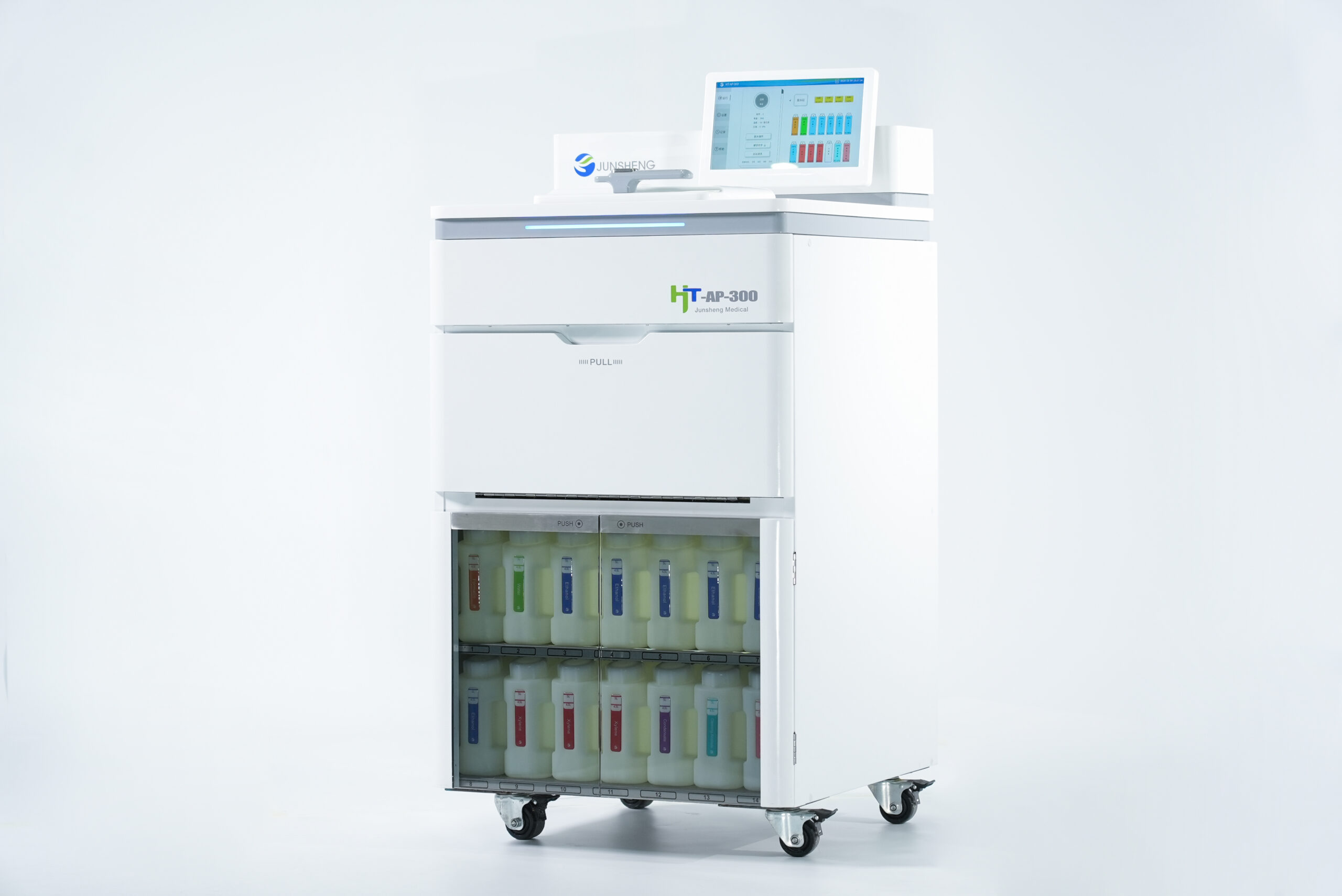
The HT-AP-600 and HT-AP-300 are enclosed retort processors — the HT-AP-600 here carries 600 cassettes across two retorts, the HT-AP-300 carries 300 in one. The reagent rack is open: 18 bottles plus 4 paraffin stations on the 600, 14 plus 4 on the 300, all 5-liter, all filled by the lab from whatever supplier they choose. No cartridge lock, no chemistry contract. Reagent management tracks concentration, cassettes processed, days, and cycles — the four numbers that actually decide when a bath is spent — with user-programmable thresholds that flag a change before specimens pay for the delay. That's the calendar problem engineered out.
For the paraffin line, an active paraffin cleaning design removes solvent residues and stretches process paraffin life. For the plumbing, an anti-block design plus a programmed water reflux between the 10% NBF and the gradient alcohols prevents the phosphate crystal blockages I've spent whole days clearing out of other machines. Heating is PWM + PID with rapid heat. Mixing runs on fluidics, ultrasound, and pressure and vacuum — active reagent distribution, even heat, both retorts.
On downtime: fault or power loss sends an SMS to preset numbers and puts the status on a web page the lab can check from anywhere. That capability is tested on the bench before the machine ships, along with the rest of the ledger logic. The 15.6-inch touchscreen (13.3 on the 300) carries 15 validated processing programs, with room for the lab's own — including delayed end times that land the run on Monday morning instead of Sunday night. Gas collection with activated carbon filtration keeps the fumes off the technicians.
The staining line here, the automatic slide stainer here, and the cassette printers here follow the same open-reagent, serviceable design, which matters when a distributor is quoting a full histology suite against a brand that locks every module. ISO 9001 and ISO 13485 cover the quality systems, with CE on selected products — worth verifying against the standards at iso.org here before any tender submission, and the competency frameworks at ascp.org here are what your customers' staff are trained against. If you are comparing enclosed processors against drum systems for a specific market, our factory page here and the contact form here are the fastest way to get the spares list and the lead times — the two numbers on line four of the ledger.
Questions Distributors Ask Me
"A tender only scores the purchase price. How do I sell TCO?" You don't sell it — you put it in the tender. Every serious tender allows an evaluation methodology, and lifecycle cost is a legitimate criterion. A one-page version of the five-row sheet above, attached to your bid, reframes the whole scoring. I've watched a 30 percent price gap lose to a two-line reagent-cost projection.
"Which markets should push enclosed retort over drum?" Modern drum processors are enclosed too — the line a distributor wins on is the reagent rack, not the chamber. Anywhere reagent logistics are hard — long import lead times, thin supplier networks, currency pressure — a drum system's rapid protocol is attractive until the proprietary reagent shipment is stuck in customs. The enclosed processor running local reagent stock shrugs.
"What breaks first, and can my technicians fix it?" Pumps, valves, retort seals — same parts on every brand I've serviced. The difference is whether your technician is allowed to replace them. Ours are standard, documented, and covered by the spares kit we set up with distributors at installation.
Closing the Ledger
That lab manager in the first paragraph? She bought the more expensive machine — the one with the open reagent rack, the remote alerts, the local spares kit. Last I heard, the folder of receipts had stopped growing thicker than anyone expected, and nobody could remember the last time a run failed overnight.
That's the quiet goal. Not the cheapest badge on the day of purchase. The machine you stop thinking about — because a ten-year ledger that closes itself is the best deal in this business.