
I was standing in a 1,200-bed hospital lab last month, watching a tech pry apart a stack of glass slides that had fused overnight. The mounting medium had overflowed, cured, and welded thirty slides into a single brick. The whole-slide scanner behind her was flashing error codes. Two stations down, another tech was bandaging a paper cut from a cracked coverslip. And the xylene smell in that room was strong enough to make your eyes water.
He asked the question I hear more and more: "Should we switch to film coverslipping?"
I've spent years installing and servicing both sides of this — glass coverslippers from Leica, film coverslippers from Sakura — and I've watched labs make the call in both directions. What follows is the same walkthrough I give anyone who asks. No brochure talk. Two questions, the mechanics, and what I'd actually specify for my own lab.
Because coverslipping is the most underrated step in the histopathology device workflow. When it goes right, nobody notices. When it goes wrong, it shows up as scanner downtime, retakes, and archives you can't fully trust ten years later.
Why Choose a Film Coverslipper Over a Glass-Slide Coverslipper?
First, let's clear one thing up, because it confuses a lot of buyers. The staining is the same. Whether your stainer feeds a glass coverslipper or a film coverslipper, the H&E staining process — hematoxylin, eosin, and the rest — runs identically. The entire difference sits in the final step: how the finished slide gets covered and protected. So this whole comparison is about coverslipping, not staining.
How glass coverslipping works. A liquid mounting medium is dispensed onto the slide, then a glass coverslip is placed on top. The medium has to cure, and it's a wet process from start to finish — which means overflow, bubbles, and positioning all need babysitting.
How film coverslipping works. Instead of a glass coverslip and liquid medium, a polyester tape with a xylene-activated adhesive is applied across the slide and sealed down. It dries almost immediately. No liquid mounting medium, no curing time, nothing to wick or overflow.
From there, the differences follow logically.
Speed and throughput. Film coverslipping is fast — the tape goes down and it's done in seconds — so the throughput ceiling is much higher. A typical glass coverslipper runs in the 300–500 slides/hour range; Leica's CV5030 is rated around 400. Film systems run roughly double: JunTeng's HT-FilmC-1000 is rated at 1,000 slides/hour, Sakura's Film Coverslipper around 1,080. Not every lab needs a thousand slides an hour. But "covered and dry right now" changes your workflow — slides can be reviewed or scanned immediately instead of waiting for medium to set.
Coverslipping quality. This is the difference that shows up in daily work. Glass coverslipping is a wet process: overflow is common, bubbles appear, coverslip placement drifts. Film is dry-applied: no overflow, no bubbles, no fragments. The tape goes down flat, every time — with high transmittance and an anti-reflection surface that keeps the view clear under the microscope.
Digital pathology and AI reading. Here's where film has quietly pulled ahead — and it's the main reason I changed my recommendation. Whole-slide scanners move slides mechanically and read them optically. Overflowing medium is the enemy of both: it sticks to transport arms, fouls optics (exactly what happened to that lab director), and leaves artifacts that scanners and AI algorithms misread. Film coverslips are flat, consistent, and artifact-free — precisely what a scanner, and an AI model trained on clean slides, wants. Some head-to-head comparisons even show film-covered slides scanning slightly faster. If your lab is heading toward digital pathology, this point alone justifies the conversation.
Long-term storage. Slides are archives. Studies comparing the two approaches have found film coverslipped slides hold up well over years of storage, with fewer artifacts than some glass-mounted slides over long periods. The slide you make today may still be read a decade from now.
Safety and maintenance. Glass breaks. Broken coverslips mean fragments in the lab and on the floor. Film has nothing to break — the tape stays intact even if a slide is dropped. And with no liquid medium, there's far less residue to clean off racks, carriers, and the machine itself.
I'm not going to pretend film is right for everyone. Low volume, no digital plans, techs who've run glass for twenty years without complaints — a glass coverslipper will do the job, and it's simpler and cheaper on the invoice. But for labs with throughput pressure, digital pathology plans, or AI-assisted workflows, film is the better fit.
| Film coverslipping (tape) | Glass coverslipping | |
|---|---|---|
| How it works | Polyester tape, xylene-activated adhesive | Liquid mounting medium + glass coverslip |
| Drying time | Near-instant | Minutes to cure |
| Overflow / bubbles | None | Common, needs monitoring |
| Fragments | None | Glass breakage risk |
| Throughput | Up to ~1,000+ slides/hour | Typically 300–500 slides/hour |
| Digital pathology | Flat, clean, scanner-friendly | Overflow can foul scanners |
| Long-term storage | Fewer artifacts in long-term studies | Medium can yellow or contract |
| Best suited for | High volume, digital / AI workflows | Low volume, established glass workflows |
If you want the longer technical breakdown of how tape coverslipping changes the digital pathology pipeline, I wrote that out separately here.
Reference: Tissue-Tek Film® Automated Coverslipper.
Why Choose JunTeng Film Coverslipping Over Sakura's Film Coverslipper?
Let me be straight first: Sakura's Film Coverslipper is a good machine. Thirty-plus years, tens of millions of slides, the benchmark for tape coverslipping. If you want the safest possible decision with zero justification required, Sakura is a defensible choice.
But I talk to distributors, not just lab managers. And the question I keep getting — more every year — is different: "Same technology route. Is there a manufacturer who can give us the same results at a price our market can afford, with a consumables story we can actually build a business on?"
That's where JunTeng comes in, and here's the argument in full.
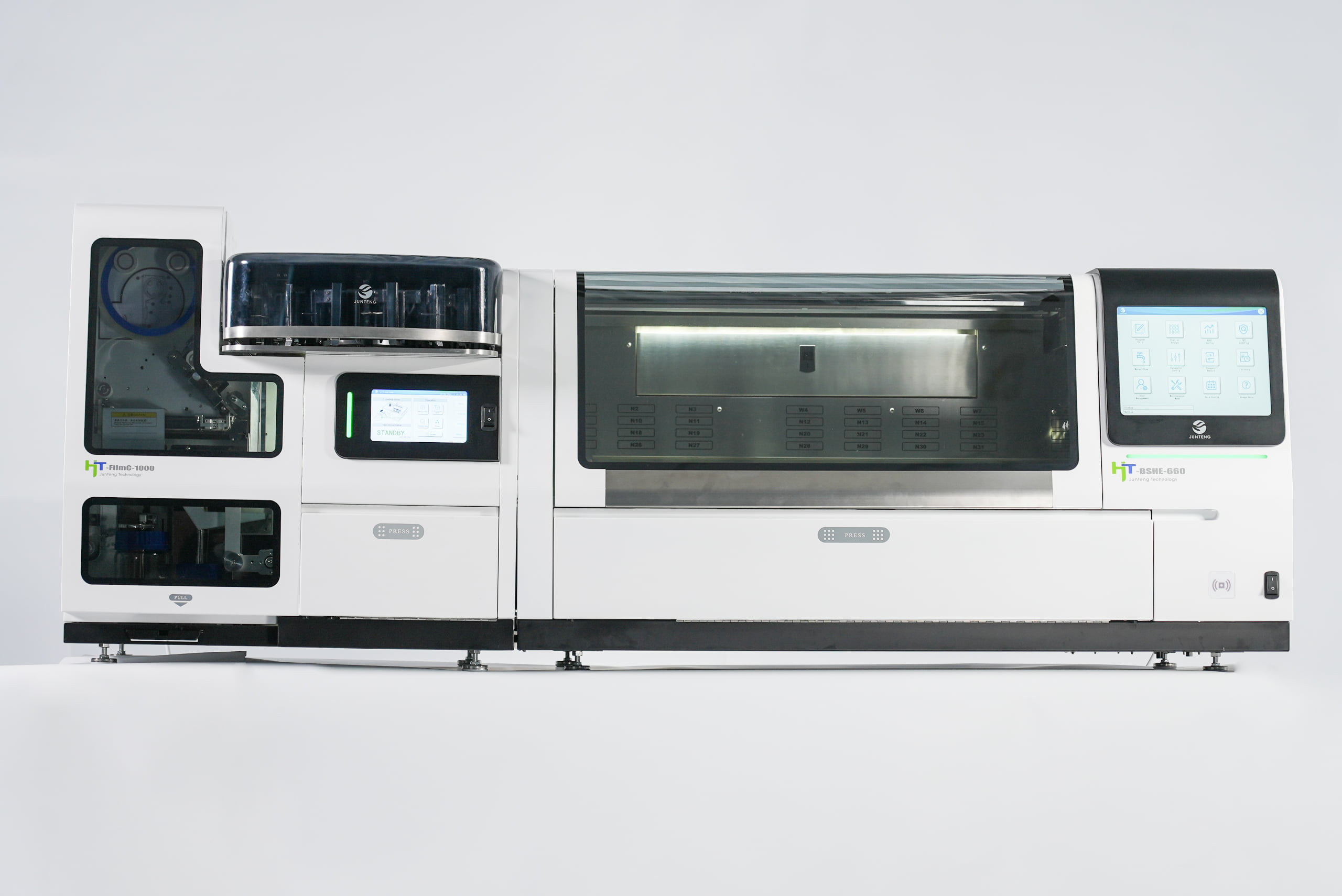
Same technology, a different cost structure. Film coverslipping is a mature technology route — the tape, the xylene activation, the roller application. JunTeng builds on the same approach, and its HT-BSHE-660 stainer and HT-FilmC-1000 coverslipper deliver the same class of performance at a significantly different price. For a distributor, that difference is margin — the gap between a catalog line and a real business.
The tape is the story. This is the part I'd want you to understand before anything else, because it changes what this partnership looks like. JunTeng manufactures its own coverslipping tape — HT-Tape — in-house. That's rare: most film-coverslipper makers don't make the consumable themselves. And here's the part distributors really like: HT-Tape is manufactured to the same roll format and application specifications as the tape used on Sakura's film coverslippers, so it works as a direct replacement on machines already installed in the field — at a lower price.
Think about what that means commercially. There are labs running Sakura film coverslippers today, buying tape from Sakura. A distributor carrying HT-Tape can walk into one of those labs with a conversation that doesn't require selling new equipment: "Same tape, lower price, same results." The lab saves money this quarter. The distributor wins a customer this quarter. And once that relationship exists — once you're the person who supplies their coverslipping tape — the equipment conversation becomes natural. You're not a cold call anymore; you're their supplier. HT-BSHE-660 & HT-FilmC-1000 product page.
That's the model in one sentence: sell the tape first, earn the trust, and the workstation follows. Machines are sold once. Tape is sold for the life of every machine you place — and every Sakura machine you can convert with a cheaper roll of consumable.
Performance that matches the route. The HT-BSHE-660 stains at 660 slides/hour with 12 staining protocols running simultaneously, and the HT-FilmC-1000 coverslips at 1,000 slides/hour. The stainer uses JunTeng's patented ASBT staining control to keep timing precise slide-to-slide, with RFID-based reagent monitoring so the machine tracks reagent age and condition — and adjusts in real time based on slide count and reagent age. Six loading stations, configurable for flexible workloads. The coverslipper holds 240 finished slides in its output storage. That's not a compromise spec; it's a parallel spec.
A genuine one-stop workstation. The HT-BSHE-660 and HT-FilmC-1000 are designed as an integrated system: from dewaxing through staining to coverslipping, fully automated, unattended. Load slides, leave, come back to covered, finished slides ready to review. The same deck runs H&E, Pap, and frozen-section staining, with an HD H&E kit built around five reagents — mordant, hematoxylin, eosin, differentiator, and bluing reagent — for consistent color run to run. Power draw stays under 2,000 W, which matters when a tender specifies existing electrical capacity.
Coverslipping quality details. The polyester tape gives high transmittance and an anti-reflection surface for clear viewing. It dries fast, with no overflow and no debris. The machine intelligently adjusts tape length to each slide, and the polymer film protects samples from dust, oxygen, humidity, and contact — exactly what a long-term archive needs.
Documents that survive a tender. When a histopathology device tender comes around, the technical file decides. JunTeng is certified under ISO 9001 and ISO 13485 at the company level, and selected models carry CE compliance — not every model, and that distinction matters when a bid names a specific unit. Spec sheets match line by line, and the team prepares tender packages in advance.
OEM and private label without friction. Many successful distributors run JunTeng hardware under their own brand — branding, packaging, and software language customized as part of the deal, not as an exception. For a bidding agent, that flexibility can be exactly what wins a tender with a local-brand requirement. See how OEM and distribution partnerships work.
None of this is a knock on Sakura — their machine is proven and their service network is mature, and if brand comfort is your priority, that's a legitimate choice. I'm telling you what I tell every distributor who asks: the gap between "established" and "right for your market" is wider than it looks. And in this, as in any IVD device purchase, the total cost, the consumables economics, and the partner you can actually reach matter more than the logo on the front.
Questions Distributors Ask Me Before Signing a Partnership
When I sit down with a distributor — at a booth, on a call, over a bad coffee at a trade show — the questions aren't about staining chemistry. They're about risk and money. Here are the ones that come up most, and the answers I give.
"Is JunTeng's tape really comparable to Sakura's?"
HT-Tape is manufactured to the same roll format and application specifications as the tape used on Sakura's film coverslippers, so it's a direct replacement in daily use. Labs that switch report no practical difference in coverslipping quality — same results, different price on the invoice.
"Can I sell your tape to labs that don't have your equipment?"
Yes — and I'd argue that's exactly how you should start. Labs already running film coverslippers buy tape constantly. Your tape fits their existing machines and costs less. That's the easiest first sale you'll make, and it opens the door for the equipment conversation later.
"How does the consumable revenue actually work?"
Simply: the machine is sold once; the tape is sold for the life of the machine. Every working day consumes tape. That's recurring revenue tied to equipment you placed — or equipment someone else placed, for that matter. There aren't many medical device lines where the consumable opportunity is this direct.
"Can you provide the documents for a tender?"
Yes — ISO certificates, CE documentation for eligible models, spec sheets, and the supporting paperwork, prepared ahead of time. If your tender needs specific formats or translations, that's handled in preparation, not after submission.
"Can you private-label the workstation?"
Yes, and it's routine — branding, packaging, and software language can all be customized. Several distributors run JunTeng hardware under their own brand as their flagship histopathology line. You can get the full specification sheet and the distributor kit here.
If you're a bidding agent, one more piece of advice: get the documents before you commit to the tender, not after. A manufacturer who hesitates on paperwork will hesitate on a warranty claim too. JunTeng doesn't.
What I'd Do If I Were Buying Tomorrow
Back to that lab director and his gummed-up scanner. After we talked it through, he asked the one question I always like: "If it were your lab, what would you buy?"
Same answer I'd give you. Film coverslipping — because the flat, dry, artifact-free result is what a scanner and an AI model want, and it's where the market is moving. And then a manufacturer whose consumables story makes sense — one where the tape you'll buy for the next ten years isn't a lock-in, but a choice you can defend. The famous name will always be there, and it's good. But "good" isn't the same as "right for your market."
If you're a distributor evaluating suppliers, or you've got a tender coming up and the technical file looks thin, email me directly and I'll send you the full spec sheet for the HT-BSHE-660 and HT-FilmC-1000, a sample of HT-Tape to test against the tape you're using now, and what we can put in front of an evaluation committee. Here's where you can reach me.