
You don't need to be in the room to spot a Monday problem. The shape of it is always the same: the QC slide from Friday is crisp, the one from Monday is pale, and the lab has already decided the stainer is dying. It isn't. Most of the time I can prove that in under ten minutes.
I've been a field service engineer for over ten years, installing and repairing stainers, tissue processors, coverslippers, and cassette printers from the big international brands. I've watched a lot of labs blame a lot of machines for things the machines didn't do. Friday's slide and Monday's slide run down the same line, but not under the same conditions. Reagent age moved. Water changed. Temperature drifted. Records disappeared. The machine stayed constant — which is exactly why it's innocent.
Think of it as an experiment with a control that was never named. Same block. Same protocol. Same hardware. Different result. The difference has to live in the variables nobody wrote down. This article is the list of those variables, in the order I chase them. If you sell or specify automated staining equipment, learn the list cold — your customers will run it on you.
1. The Hematoxylin Ran Out of Legs
Symptom. Nuclei are pale and washed out. Not absent — just weak. The slide looks like it was stained by someone in a hurry.
How I judge it on site. I ask for the run log and lay slides out in the order they were stained. Dye exhaustion has a signature: slides get progressively weaker through the life of the bath. If slide one of the reagent's life is strong and slide three hundred is pale, that's not a machine fault — that's chemistry doing its job. A shiny film on the hematoxylin surface means the bath needs filtering too.
Root cause. Hematoxylin oxidizes as it works. Every slide that passes through pulls dye out of the bath, and exposure to air does the rest. The insert that came with the reagent states a change interval, usually in slides — and in a busy lab, nobody is counting.
What to try first. Run one control slide with the nuclei step extended by thirty to sixty seconds. If the intensity comes back, you've confirmed reagent age, not the machine. Change the bath, log the slide count. If extending the time does nothing, keep reading.
2. The Water Changed Over the Weekend
Symptom. Nuclei come out red or purple instead of blue. Or the eosin looks rinsed away. Everyone blames the hematoxylin first. Usually wrong.
How I judge it on site. Bluing depends on the wash water being alkaline enough. I ask two questions: what's plumbed into the wash station — tap, deionized, or a bluing reagent — and did anything change with the building's water supply. Deionized water has no alkalinity at all. A softener regenerated over the weekend changes the game. The fast test: re-run one slide with a bluing reagent substituted for the wash. If the color snaps to proper blue, you've found it.
Root cause. Alum hematoxylin nuclei go blue in an alkaline environment. If the water lacks that alkalinity, the blue never develops, no matter how good the hematoxylin is. Water quality varies by building, by season, and by whatever the facilities team did on Saturday.
What to try first. Replace the wash with a proper bluing reagent. Standard practice, and it removes the variable entirely. I've closed more "broken stainer" calls with a bottle of bluing reagent than with a toolbox.
3. Nobody Wrote It Down
Symptom. Stain quality drifts week to week with no pattern. Two techs give you two different stories about when the reagents were last changed. Both might be right.
How I judge it on site. I ask three people, separately, when the eosin was last changed. Three different answers, and I've found the problem. Then I look at the machine: unlabeled bottles, no log sheet taped anywhere, alcohols of visibly different ages sitting in the same gradient.
Root cause. Reagent rotation without records isn't rotation — it's luck. Alcohols load up with water, xylene loads up with alcohol, eosin slowly dies, and none of it is tracked. This is why histology quality programs lean so hard on documentation, and why the NSH keeps pushing reagent management education. Machines that track reagents electronically make this trivial. Machines that don't make it a clipboard problem, and clipboards fail on Fridays.
What to try first. Don't replace everything at once. Start the log first — date, slide count, initials on every bottle. Within two weeks you'll see which reagent is drifting past its life, and you'll stop replacing reagents that were fine.
4. The Building Breathed Out on Saturday
Symptom. Monday's first run is pale or patchy, dewaxing looks incomplete, and by Tuesday everything is normal again. That "recovers by itself" pattern is the tell.
How I judge it on site. I ask what happens to the HVAC between Friday evening and Monday morning. In plenty of buildings the answer is "nothing" — the system drops to standby and the lab drifts several degrees over the weekend. I leave a min-max thermometer on the bench for a week. And on Monday at seven, I put my hand on the xylene bottle. If it's cold, the reagents are cold.
Root cause. Temperature drives every step in an automatic staining line — dewaxing, dye uptake, dehydration. Cold reagents work slower, plain and simple. The protocol assumes reagents at working temperature. Monday morning, they aren't.
What to try first. Delay the first run until the room and reagents have warmed, or add time to the dewaxing steps in a "Monday morning" protocol variant. Longer term, get facilities to hold a minimum setpoint over the weekend. That conversation is cheaper than a service contract argument.
5. Water Sneaking Into the Alcohol Chain
Symptom. Slides look hazy under the scope. Eosin is uneven. Coverslips come out cloudy and the coverslipper takes the blame.
How I judge it on site. Water carryover has a direction — the first alcohol after the water wash degrades fastest, then contamination walks up the line. I check the alcohols in order and look hard at the final xylene. Cloudy xylene means water got past the gradient. In my experience, if the last xylene is going milky, the whole back half of the line is tired.
Root cause. Every slide drags a film of water out of the wash. Too many slides, and the first alcohol becomes part water. The gradient loses its ability to dehydrate, and everything downstream suffers — including the coverslipper, which gets accused of what the alcohols did.
What to try first. Change the first alcohol and the final xylene, and shorten the interval between changes. If the haze disappears for a week and then returns, it's a workload question, not a machine question.
6. One Slide, Patchy Stain
Symptom. Not the whole run — a single slide with streaks or bare patches. Neighboring slides on the same rack look fine.
How I judge it on site. I stand there and watch a rack move through the problem bath. Is there agitation? Are bubbles moving? A bath that stirs quietly and evenly looks boring, and boring is what you want. Then I check the pump filter — a clogged filter starves agitation long before anything alarms.
Root cause. Staining is diffusion. Still reagent next to a slide gets locally exhausted, and nothing replaces it. This one usually is a machine issue — but a maintenance issue, not a "buy a new stainer" issue.
What to try first. Clean or replace the filter, run a test rack, and see whether the patchiness moves or disappears. If it persists on the same rack position every time, you're looking at a mechanical fault, and that's a different visit.
Monday Morning Triage, in Six Lines
| What you see | Likely factor | Fast check |
|---|---|---|
| Slides weaken as the week goes on | Hematoxylin exhaustion | Extend nuclei time on one test slide |
| Red nuclei, eosin washed out | Wash water alkalinity | Substitute bluing reagent for the wash |
| Pale Monday, normal by Tuesday | Weekend temperature | Min-max thermometer over one weekend |
| Three techs, three change dates | No rotation records | Start a log before replacing anything |
| Hazy slides, cloudy xylene | Water in the alcohols | Change first alcohol and final xylene |
| One patchy slide in a good run | Agitation or filter | Watch the bath; clean the filter |
The Checklist I Leave Behind
Before I close a Monday call, I tape one page to the side of the stainer:
- One control slide every morning, before any patient material hits the line
- Every bottle labeled with the date it went in and the slide count at the change
- The reagent insert's change interval, posted where people can see it
- A min-max thermometer on the bench for at least two weeks
- Wash water chemistry: known, not assumed
- A monthly look at the pump filter, whether it looks dirty or not
Run that list for a month and most "sometimes good, sometimes bad" complaints quietly die. External quality programs like the ones run by the CAP will tell you the same thing from the other direction: consistency problems trace back to process far more often than to hardware.
Now, About Our Own Machines
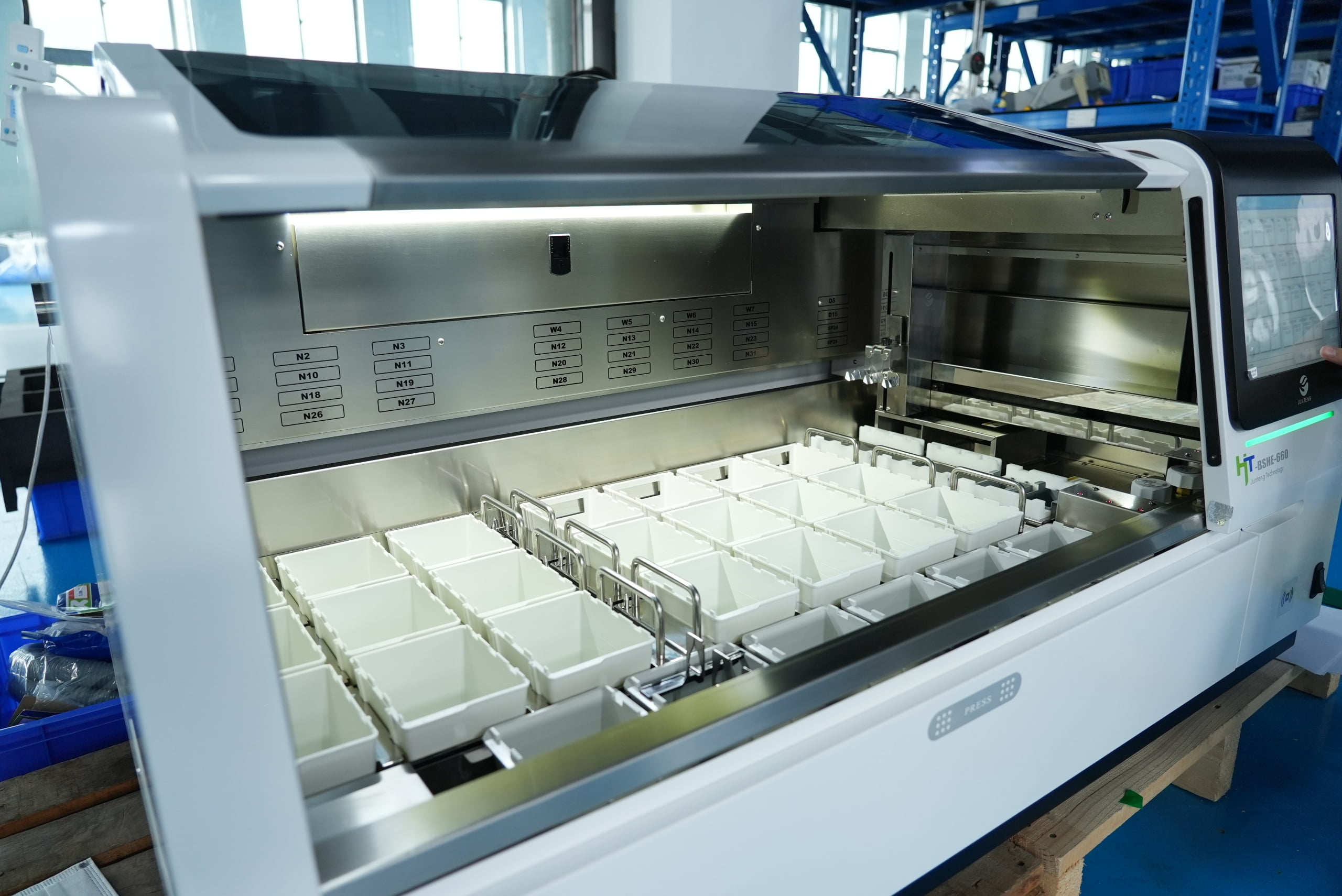
I don't write troubleshooting stories to pretend machines don't matter. They do. But after a decade of cleaning up these root causes — reagent decay, water, records, temperature — I can tell you which ones a well-built automated staining line can take off the table entirely. When we built the JunTeng HT-BSHE-660 stainer and HT-FilmC-1000 coverslipper, the engineering team worked these failure modes down one by one, and every unit runs through verification against them on the factory bench before it ships. Here's how each root cause maps to something the machine simply does for itself.
Dye exhaustion. The stainer tracks two variables at once: how many slides a reagent has processed and how old it is. Our patented ASBT system uses those numbers to adjust protocol timing in real time. As a hematoxylin bath moves through its life, the machine stretches the nuclei step instead of waiting for a human to notice pale slides. Scenario 1 doesn't get solved by a log sheet on our line. It gets solved by arithmetic, continuously, without anyone's coffee going cold.
Records. Every reagent bottle carries an RFID tag. The machine knows what went in, when it went in, and how many slides have passed through it. Scenario 3 — three techs, three answers — can't happen when the answer is already on the screen. That single feature removes most of the Monday morning phone calls I used to drive to.
Water. Our H&E staining kit is a closed set of five reagents — mordant, hematoxylin, eosin, differentiator, and bluing reagent — formulated together so that first-to-last-slide uniformity holds across the machine's full processing capacity. The bluing reagent matters most here: nuclear bluing no longer depends on whatever the building's pipes deliver. Scenario 2 stops being your customer's problem the day the kit goes in.
Timing and drift. Precise slide counting underlies every protocol step — the machine times against actual slides processed, not assumptions. Protocol steps adjust to real workload, which is the honest fix for the temperature-and-load drift in scenario 4, not a sticker on the door.
What the factory bench checks before shipping. Staining uniformity from the first slide to the last within rated capacity. Bluing that holds regardless of local water. Timing that holds against slide count. Coverslip film applied with no overflow and no debris in the output. Anything that drifts doesn't get past the bench. It's the same checklist I used in the field, run in reverse, before the customer ever sees the machine.
Throughput and range. 660 slides per hour on the stainer, 1,000 per hour on the coverslipper, twelve protocols running at the same time. Six configurable loading stations, with reagent tanks sized for real workloads — 750 ml large, 260 ml small — so a lab can run routine H&E, Pap, frozen sections, and special staining side by side without reconfiguring between batches. The coverslipper's output tray holds 240 finished slides, so one tech can load, walk away, and come back to a full rack. If you're specifying a full automated coverslipping & staining workstation for a tender, the integrated system spec is here, and the standalone automatic staining unit is here.
The coverslipper end. Tape coverslipping deserves its own word, because it inherits the alcohol-chain problem from scenario 5. No liquid mounting medium means nothing to cloud, nothing to set, no wet-slide haze on a humid Monday. The polyester film is high-transmittance and anti-reflective, dries fast, and leaves no overflow or debris to clean from the output. The coverslipper is here, and the film that makes the back end boring is here.
Questions Distributors Ask Me
"A customer calls with pale Monday slides on a competitor's line. Do I pitch?"
Not yet. Walk them through the triage table for free. Half the time you'll fix their problem without selling anything — and you'll be the first call they make when that machine truly is done. I wrote about the same logic from the coverslipper side here.
"What's the realistic service burden after install?"
From the reagent side, close to zero — RFID tracking and ASBT adjustment remove most of the calls I used to make a living on. What comes back is usually protocol setup questions, which is the good kind of call to get.
"What should I write into a tender?"
Three lines: slide-count-based reagent management, protocol auto-adjustment by reagent age and load, and bluing independent of tap water. Machines that can't do those three things quietly disqualify themselves, and you never had to name a brand.
One Last Thing
Machines get blamed for a lot that isn't the machine. Weekend thermostats, regenerated softeners, unlabeled bottles, a filter nobody remembered. When a lab says their staining is "intermittent," that word is the diagnosis: something in the process is intermittent, and the hardware is just the messenger.
The best staining line earns silence. Nobody calls you on a Monday to say the slides look the same as Friday's. If you want fewer of those Monday calls, quotes and spec sheets start here.