
Most buyers ask me the same question first: how many slides can it stain per hour?
It is a fair question—and the number most likely to mislead the purchase. Protocol conflicts, reagent changes, urgent slides, or a slower coverslipper can leave racks waiting even when the stainer looks fast on paper. The machine may be fast while the laboratory remains slow.
When I evaluate an automated slide stainer, I start with the workload as it actually arrives—not the maximum number printed in the brochure. Here are the ten points I would check before recommending a system or writing it into a tender.
1. I Start With the Workload, Not the Machine
Tell me that a laboratory processes 500 slides a day, and I still do not know what size stainer it needs. I need the peak arrival pattern, protocol mix, urgent-rack requirements, and repeat or restain frequency. Five hundred slides spread across a full shift are different from 350 arriving after the morning cutting session.
Before comparing equipment, I would record:
- Average slides per day
- Peak slides per hour
- Routine and occasional protocols
- Urgent-slide requirements
- Operating hours and staffing
- Expected growth
- Repeat and restain frequency
This shows whether the laboratory needs raw speed, scheduling flexibility, or both.
2. I Do Not Treat Capacity and Throughput as the Same Number
Capacity tells you how many slides or racks a system can hold. Throughput tells you how many slides complete a process over a defined period and under defined conditions. Neither number tells you exactly what the laboratory will produce during a real shift.
Usable throughput also depends on protocol duration, rack loading, reagent-station layout, cleaning, urgent work, unloading and the next machine in the line. One histology study measured productivity and turnaround after combining an automated stainer with Lean changes across the workcell. Because the intervention combined equipment and workflow changes—and included a co-author affiliated with the stainer manufacturer—I use it to support measuring the whole workflow, not to estimate the effect of a stainer alone (Hassell et al., BMC Clinical Pathology). If the coverslipper cannot accept the output, the queue has only moved downstream.
For an initial estimate, I use:
Required hourly capacity = peak workload / available production hours, plus a realistic buffer
That is a sizing tool, not an acceptance test. I would still ask the supplier to explain the test conditions and demonstrate a comparable case mix.
3. I Separate H&E, Special Stains and IHC Before We Talk About Models
Not every stain belongs on the same platform.
Routine histology laboratories usually need H&E. Some also run Papanicolaou staining, frozen-section protocols, or selected special stains. Immunohistochemistry is an antibody-based process and normally belongs to a different instrument category.
I would list daily, occasional and manual protocols, then identify reagents that must remain separate and programs that may run together.
This prevents a common purchasing mistake: choosing a machine with an impressive maximum output that does not fit the laboratory's actual protocol mix.
4. I Ask What Happens When Two Protocols Need the Same Station
A fast single protocol does not guarantee a fast laboratory.
If every new rack must wait for the current batch, the stainer may create delays despite an excellent published throughput. I ask:
- Can racks be loaded continuously?
- Can different programs run at the same time?
- Can an urgent rack enter without disrupting everything else?
- What happens when two protocols need the same reagent station?
- How many loading and unloading positions are available?
The number I care about is not only cycle time. It is the time from a slide becoming ready for staining to that slide becoming ready for coverslipping.
For laboratories running several protocols, scheduling flexibility may be worth more than a higher theoretical maximum.
5. A Reagent Reminder Is Useful, but It Is Not Reagent QC
Hematoxylin does not perform the same way forever. It can be affected by carryover, dilution, oxidation, temperature, workload and time in service. Water quality and other reagents matter too. A study of H&E staining in 247 laboratories participating in the UK NEQAS CPT EQA programme found measurable colour variation. Most labs (69%) received good or excellent expert scores, and the authors noted a core of good inter-laboratory agreement. They also caution that the participating labs do not represent all laboratories globally. The observed variation is a reason to monitor staining quality, not a general failure rate (Dunn et al., Journal of Pathology Informatics). A separate peer-reviewed review describes quality assurance across fixation, embedding, microtomy, staining and coverslipping (Wick, Seminars in Diagnostic Pathology).
When I review reagent management, I want the system to answer four questions:
- How long has the reagent been in service?
- How many slides have passed through it?
- Which replacement rule is being used?
- What happens when the limit is reached?
I check whether operators can review the history and authorised users can control the rules. A reminder records usage; it does not prove suitability. The laboratory still needs a validated protocol, controls and a replacement policy.
6. I Am Careful With Claims About “Consistent Staining”
Automation can standardise timing, movement and the sequence of steps. That matters. It cannot correct every problem that reaches the stainer.
Fixation, tissue processing, section thickness, slide adhesion, drying, water quality, reagent condition and coverslipping can all affect the final H&E slide. The peer-reviewed Wick review in Seminars in Diagnostic Pathology covers these stages. I have also written about why an H&E staining problem may begin upstream of the stainer; check that workflow before assuming the instrument is the cause.
I ask the supplier to identify what the machine controls: immersion time, agitation, wash steps, station selection or rack movement. These controls should not become a promise of a particular diagnostic result.
The defensible claim is that automation supports more standardised and repeatable process conditions.
7. I Check the Room Before I Approve the Equipment
I would not finalise a slide stainer quotation without checking the installation site.
Low water pressure may affect washing; excessive pressure may disturb sections. Local water quality can also change staining behaviour, so some laboratories may need treated or deionised water.
The site check should cover:
- Water connection, pressure and quality
- Drain location and waste route
- Electrical supply and maximum load
- Equipment footprint and transport access
- Service clearance
- Room ventilation
- Solvent handling
- Power-interruption procedure
An enclosed instrument with activated-carbon filtration may help manage vapour generated inside the machine. It does not replace a laboratory ventilation assessment. Xylene and other chemicals still have to be managed under the requirements that apply at the installation site.
8. I Treat Coverslipping as Part of the Same Capacity Decision
Staining is not finished when the rack leaves the last reagent station.
If the coverslipper cannot keep up, finished racks wait on the bench, adding handling and delaying review.
I compare peak stainer output with coverslipper capacity, rack compatibility, transfer steps and storage. If either side stops, can racks be recovered safely, and where do completed slides wait?
A physical connection between two machines is helpful, but it is not enough. Workflow integration should be judged by how the line behaves when something does not go according to plan.
9. I Ask About Maintenance Before I Ask About Warranty
Warranty length is easy to compare. Daily maintenance is what the laboratory will actually live with.
I want to know the daily cleaning time, operator-replaceable parts, and locally stocked consumables and spares. I also check error records, power-interruption recovery and remote diagnosis.
For a distributor, this becomes a channel decision as well as a technical one. A good machine can still become a poor project if installation, training and first-line troubleshooting cannot be supported in the target market.
10. I Write the Tender Around Evidence, Not Adjectives
“High-throughput,” “intelligent” and “fully automatic” sound useful, but they are not acceptance criteria.
I would convert them into requirements that can be demonstrated:
| Tender requirement | What I would ask the supplier to demonstrate |
|---|---|
| Supported applications | The required H&E, special-stain or frozen-section protocols |
| Peak workload | Throughput under conditions comparable to the laboratory's workflow |
| Simultaneous programs | How scheduling and station conflicts are managed |
| Reagent management | Usage records, replacement rules and operator notifications |
| Utilities | Water, drainage, power and ventilation requirements |
| Downtime recovery | Alarm records, interruption handling and restart procedure |
| Workflow integration | Loading, unloading and coverslipper connection |
| Project delivery | Installation, training, documentation and acceptance testing |
I would not copy a manufacturer's product description into a tender. Performance-based specifications make comparison and acceptance clearer.
Where I Would Bring the HT-BSHE-660 Into the Comparison
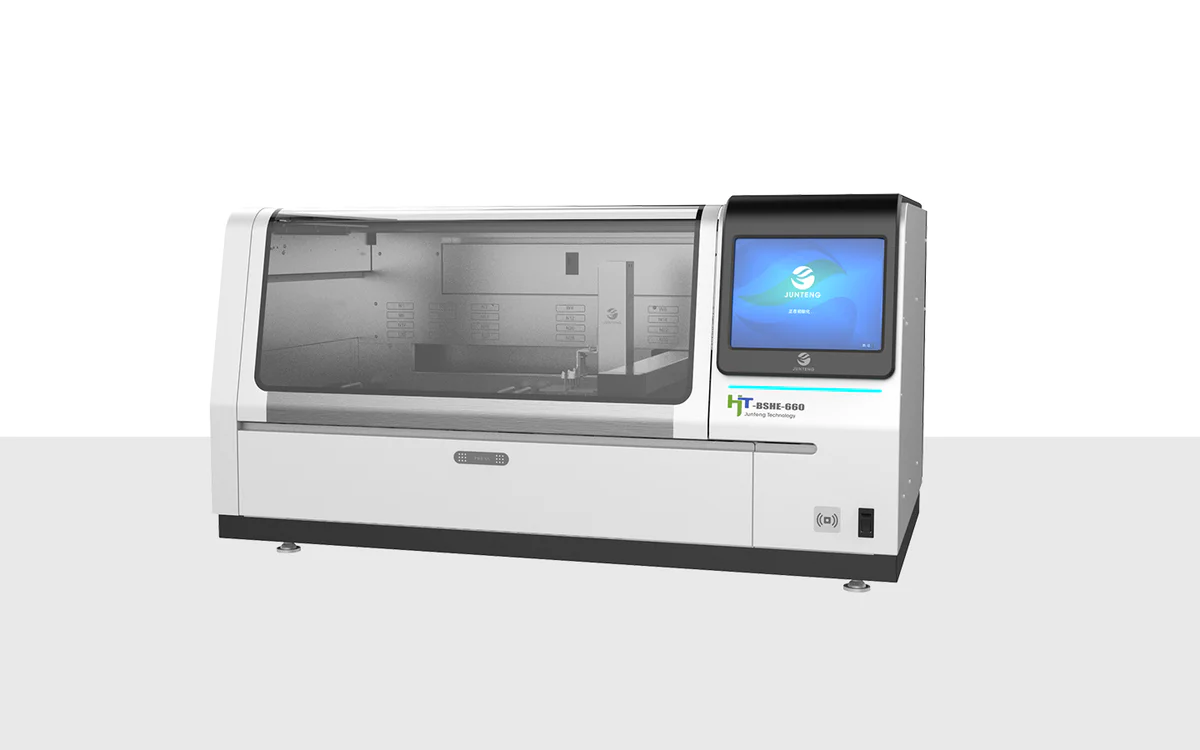
For a laboratory that genuinely needs several programs running at the same time, I would include the HT-BSHE-660 automated slide stainer in the evaluation.
It is designed for routine H&E, selected special-stain and frozen-section workflows. The system is specified for up to 660 slides per hour, supports up to 12 simultaneous staining programs, and stores up to 200 protocols. It also provides 17- or 34-reagent-station modes, with large- and small-tank configurations for different workload patterns.
Those numbers matter only when they match the customer's protocol mix. Twelve simultaneous programs help only when that flexibility is needed.
Reagent-use monitoring and replacement reminders help the laboratory track usage and manage changes. Automated program control and slide transfer support repeatable timing. HIS/LIS connection support brings the stainer into the laboratory's wider information workflow; confirm the interface and data responsibilities for each project.
For a continuous downstream process, the HT-BSHE-660 can connect to the HT-FilmC-1000 staining and coverslipping system. The coverslipper is specified for up to 1,000 slides per hour and provides storage for up to 240 completed slides. The higher downstream nominal capacity is intended to reduce the risk of coverslipping becoming the bottleneck, although the complete line should still be evaluated with the customer's protocols and loading pattern.
The equipment uses an enclosed structure with activated-carbon filtration and provides startup self-checking and remote monitoring functions. JunTeng Medical's full product range carries ISO 9001, ISO 13485 and CE certification. Buyers comparing the stainer with a connected line can review the HT-FilmC-1000 coverslipper details alongside the integrated system page.
Before recommending a configuration, I would ask for the daily and peak volume, protocol list, reagent preferences, utilities, coverslipping requirements and local service plan. That moves the discussion from a brochure comparison to a workable project.
My Final View
If you are choosing an automated slide stainer, I would follow this order:
- Map the real workload.
- Separate routine, special and urgent protocols.
- Calculate peak demand rather than daily average alone.
- Verify reagent and installation requirements.
- Check the staining-to-coverslipping workflow.
- Write measurable acceptance criteria.
I would choose the system that makes the whole staining process easier to control, verify and support.
References
- Dunn et al. An international study of stain variability in histopathology. Journal of Pathology Informatics (2025)
- Wick. The hematoxylin and eosin stain in anatomic pathology: An often-neglected focus of quality assurance in the laboratory. Seminars in Diagnostic Pathology (2019)
- Hassell LA, Glass CF, Yip C, Eneff PA. The combined positive impact of Lean methodology and Ventana Symphony autostainer on histology lab workflow. BMC Clinical Pathology. 2010;10:2.