
Ten to Five, at the Reagent Cabinet
At ten to five a technician stands at the reagent cabinet, one hand on a bottle of xylene, the other on the processor's log. Station one has gone the colour of weak tea. The log says eleven days. But last week brought three frozen cases after hours and a batch of fatty breast tissue that drank the alcohols down. Change the solvent and discard something that may still have a week in it, or run one more night and hope the blocks come out clean? Nobody in the room can answer with a number. The manual counts days. The tissue counts state. Most of the money a lab spends on processing sits in that gap — and in my experience reagent condition is the part of it that goes wrong quietly.
The Cost That Is Not on the Quote
A tissue processor is sold like a machine and paid for like a subscription. The purchase price is the entrance fee. What runs for the next ten years is a slow river of formalin, alcohol, xylene and paraffin, plus the technician time to carry it and the batches re-run when it stops doing its job.
I have made this argument before about coverslipping — the real cost of a coverslipper is the tape, not the machine. Processing is the same arithmetic with a longer tail. Nothing on the quote tells a buyer what tissue processor reagent cost will be in year three, and two labs cutting the same number of blocks on the same four chemicals can end up far apart.
This is not another architecture article — we covered reagent chamber versus carousel elsewhere. The chamber does not set your reagent bill. Histology reagent management comes down to chemistry, counting and five questions.
What Actually Ages a Reagent
Four things, none of them on the calendar.
Dilution. Alcohols take on water from the tissue they are dehydrating, so their concentration changes as workload accumulates. A processing alcohol gives up dehydrating power as it takes up moisture, which is why deciding on a tissue processing reagent change is a workload question, not a calendar question.
Carryover. Reagent does not stay in its own station. A study in the Journal of Histochemistry and Cytochemistry found that formalin contaminates the downstream alcohol, xylene and paraffin to some degree, because reagent travels on the basket, tubing and tissue itself. Read the formalin carryover study
Solvent left in the wax. Blocks moving from xylene into molten paraffin carry clearing agent with them. A little is normal; the amount is what matters, because it changes how the wax behaves at the microtome.
Accumulation. Reagent does not reset between runs. Each cycle carries some material from one stage into the next, and over repeated runs that carryover accumulates.
So: calendar, or count? Technologists argue this in public, usually as a choice between counting runs and counting cassettes — and in my experience neither number tells the whole story. Days in service describe the age of the chemistry; cycles, how often the reagent has been used; cassette load, the workload placed on it; concentration, what is actually in the bath. A published processing SOP leans the same way: at 300 to 500 blocks a day, first absolute alcohol every other day, xylene every third day, wax weekly, formalin daily. No counter is a proxy for the others, which is why a reagent system worth buying reports more than one.
Three Chemical Problems That Cost More Than the Reagents
One: crystals in the line
In my experience some labs meet deposits in the fluid path when buffered formalin is followed directly by higher-concentration alcohol. The mechanism is unglamorous: the phosphate buffer that holds formalin near neutral dissolves in water and much less so in alcohol, so where the two meet, crystals can form in tubing, valves or the chamber — first a line that runs slow, then a run that stops. Histology discussion lists have carried the warning for years; the workaround is rinsing with water between the formalin and the first alcohol. Which makes it a fair question for a supplier — does the fluid path do that by design, or does the lab own the problem? A blocked line is not a reagent cost; it is a lost run, and those are expensive at two in the morning.
Two: wax that has gone dirty and brittle
Clearing agent carried into the wax pot can affect the quality of paraffin infiltration. If contamination becomes significant, blocks may behave poorly at the microtome — soft, crumbly or otherwise difficult to section. Underprocessed tissue — from clearing or from infiltration — is also a familiar cause of sections that stain weakly. Labs rotate wax pots for this reason — discard the first, freshen the last. It works, and every rotation costs a pot of paraffin and somebody's afternoon.
Three: vapour, and the person standing next to it
The cost of an open reagent path is partly paid in air, as xylene occupational exposure and formaldehyde vapour. In the United States, formaldehyde carries a permissible exposure limit of 0.75 ppm over eight hours, a 2 ppm short-term limit, and a 0.5 ppm action level that triggers monitoring. Xylene carries an OSHA eight-hour limit of 100 ppm, with a 150 ppm short-term limit set by ACGIH. Those are occupational exposure limits, not targets for routine laboratory conditions. A NIOSH health hazard evaluation at a university pathology department measured xylene exposures below them and still recommended better ventilation and improved work practices. Read the NIOSH evaluation
Limits aside, an open path leaks where the technician stands — the same bench where cassettes are loaded.
Five Questions to Ask the Supplier
When a distributor asks how to compare two machines on tissue processor running cost, I give them five questions. Two of them are really questions about tissue processor maintenance that no brochure mentions. A weak answer to any of them tells you more than a specification table does.
| Question | Weak answer | Answer you can build a budget on |
|---|---|---|
| What does the machine count? | "It reminds you to change reagents." | Counts concentration, cassette load, days in use and cycle count, each with a threshold the lab sets |
| Can the threshold be changed? | "The schedule is fixed by the factory." | Lab programs its own warning limits, per station |
| What happens to the wax? | "The wax is filtered." | Solvent residue is actively removed from processing paraffin to help control carryover |
| What stops a blocked line? | "Clean the tubing." | Debris tolerance in the path plus a water return between formalin and the first alcohol station |
| What happens to the vapour? | "The lid closes." | Vapour is collected and passed through carbon filtration, not released at the bench |
Tissue processor reagent management is where those five answers land, and it is not a feature you bolt on at the end of a spec sheet. It is the difference between a lab that knows when to change a bath and one that guesses — guessing has two failure modes: too early wastes reagent, too late wastes a run. A run that has to be repeated is paid for twice. Ask the five questions in writing. Spoken answers are generous; written ones get specific.
How the HT-AP Series Answers Those Five Questions
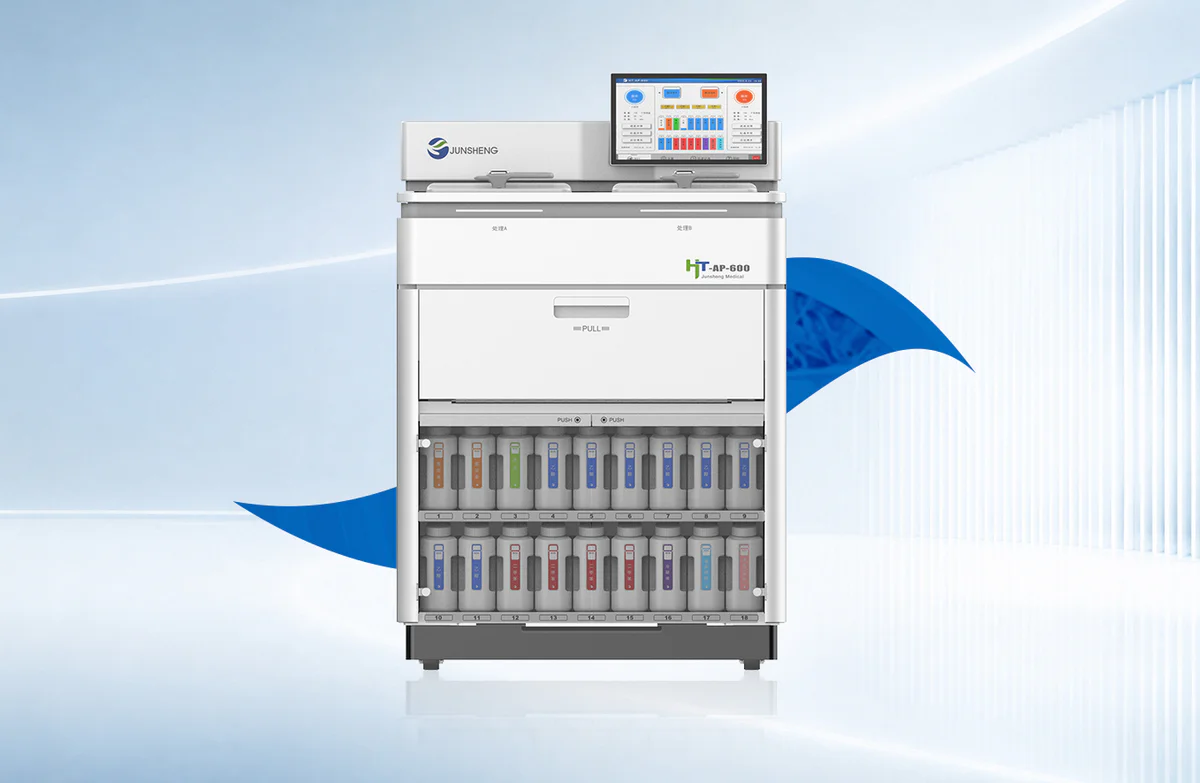
Every question above maps to a design decision on our enclosed automated tissue processors: HT-AP-600 with twin chambers, HT-AP-300 with a single chamber. Their 600 and 300 cassette figures describe how much the chamber holds per run — a capacity figure, not a daily throughput.
What the machine counts. The reagent management system tracks four dimensions — concentration, cassette load, days in use and cycle count — so "change it or run it?" is answered on the screen rather than by a technician at ten to five.
Whether the lab sets the limits. Warning thresholds are user-programmable — a lab running fatty breast all week is not held to the schedule of a lab running needle biopsies.
What happens to the wax. Paraffin is actively cleaned of solvent residue during use, which helps limit how much carried-over xylene builds up in the pot.
What stops a blocked line. The fluid path tolerates tissue debris, and a water return sits between the 10% NBF station and the first alcohol station, helping to reduce the risk of phosphate deposits in the fluid path.
What happens to the vapour. Vapour is collected and passed through activated carbon filtration, helping reduce solvent odour and the vapour released into the work area.
Those five answers are a useful way to define the requirements. The rest of the specification — chamber mixing, heating control, sensing, logging, the interface — belongs on a spec sheet rather than in an article about running costs.
One figure does matter here because it determines how much reagent the system can hold at one time: 18 reagent positions of 5 L on the HT-AP-600 and 14 on the HT-AP-300, plus four 5 L paraffin positions on each. The company holds ISO 9001 and ISO 13485, and the products carry CE. JunTeng tissue processor range
Questions Distributors Ask Me
"Won't the buyer just say reagents are reagents?" Some will — and for a small lab they may be right. A lab running one basket a day on a fixed rotation is not losing much, and plenty of brands manage reagents well enough that this is not a reason to change supplier. Say so out loud. The conversation that lands is with a lab already rotating wax pots by hand and logging reagent days on a paper chart.
"What do I put in a tender?" Four lines that describe management rather than chemistry: reagent monitoring by concentration, cassette load, days and cycle count; user-programmable warning thresholds; active removal of solvent residue from processing paraffin; and a water return between the formalin and alcohol stations. Those are checkable requirements, and most competitor sheets answer only some of them.