
A lab manager once asked me which processor to buy. Not which brand — which size. I asked one question back: "How many blocks do you embed on an average day?" She paused. "I'd have to check."
That pause is the whole problem. In more than a decade of installing and repairing histology equipment, I've rarely walked into a lab that had done the arithmetic before signing. Sizes get picked the way people pick a car: budget, floor space, what the lab down the street runs.
Buy too small and the bill arrives on a Monday morning, when 600 cassettes sit at the embedding bench and the machine holds 300. Buy too large and you pay for years of empty retort — capital that does nothing, reagent aging in 5-liter bottles, heat wasted on nights when half the chamber is empty.
Both failures are common. Both are avoidable with three numbers and a pencil. Here is the method I use on site, and the version I hand to distributors so they can run it on any customer's desk.
Why the Arithmetic Never Gets Done
Tenders are written around budgets and brands, not workload. A specification says "capacity not less than 300 cassettes" and the vendor quotes the smallest machine that clears the line. Nobody asks how many blocks the lab embeds, because nobody on the purchasing side owns that number.
So the first job of sizing is administrative, not technical: find the number, and make the customer find it too. A distributor who walks in with the formula below — not a brochure, a formula — is already different from everyone else quoting the same tender.
Step One: Count Blocks, Not Wishes
The whole calculation starts with one number: average daily blocks. Not "about 200." Not "we're growing." A number you can defend.
Three ways to get it. Pull the monthly specimen count from the LIS. Count cassettes in a week of trash. Or stand at the embedding station and count a full day. Any of these beats a guess.
Then find the peak. Labs do not run at their average. Monday carries Friday's surgeries plus weekend accessions. The week after a holiday is worse. In my experience the busy day runs 1.5 to 2 times the average in any active lab. That peak is what the machine has to swallow, not the average.
The Formula I Scribble on the Bench
Once you have the numbers, the arithmetic is three lines:
Daily capacity = load per run × runs per day.
Load per run = rated cassettes — one slot, one block, whatever the specimen size.
Runs per day = how many full programs fit in 24 hours. An overnight program means one run a day. A short protocol might squeeze in two. Most labs live on one.
One more thing worth stating plainly, because buyers ask: every embedding cassette is the same size, and every cassette holds one block. A large specimen takes one slot; a tiny biopsy takes one slot. The rating is a slot count, and the slots fill. There is no hidden derating to guess at — the arithmetic above is the whole arithmetic. The levers that decide the right size are runs per day and the gap between average and peak, not a discount.
Worked example: a lab embeds 400 blocks on its peak day and runs one overnight batch. That is 400 cassettes in one run, and a 300-rated machine cannot hold them. The size lands on 600.
A second reality check on runs per day. The label on the machine says cassettes, not cycles. A 300-rated processor running one overnight program processes 300 cassettes a day; the same machine on a two-run schedule processes 600. So when a lab tells me "we embed 500 a day," my first question is not which machine — it is how long the program runs and whether a second, shorter validated program exists. Most labs have that validation data buried in their own records; they have simply never been asked.
If you are weighing an enclosed retort processor against a drum-type machine, the sizing logic is the same but the running costs are not — I wrote that comparison here.
Five Sizing Mistakes I Keep Finding On Site
Mistake 1: Sized to the Average, Broken by Monday
Symptom. The classic pile-up. Cassettes waiting at the bench while the machine is mid-run and will not free up until afternoon. Techs rush half a week's blocks through a hurried cycle, and hurried dehydration is how you get blocks that shatter on the microtome or come out rubbery.
How I judge it on site. I ask for the last month of specimen numbers from the LIS and compare the peak day against the machine's rating. The gap is usually 1.5 times or worse.
Root cause. Sizing to the monthly average instead of the peak.
What I try first. Re-schedule before re-purchasing. Start the run earlier so it finishes before the Monday rush. Split the load into two runs. That fixes the week, not the problem. The structural fix is a machine rated for the peak, with a delayed-end program that lands the Monday run finished and ready to embed by 8 a.m. — and what happens when that run fails instead is a story worth reading before you size anything.
Mistake 2: Counting Blocks, Forgetting Time
Symptom. A lab with a "big enough" machine that still falls behind. The rating looks right. The runs are full. Blocks still wait a day.
How I judge it. I count runs per day. If every program is an overnight run, a 600-rated machine delivers 600 cassettes a day, full stop.
Root cause. People compare daily block counts to the cassette rating as if they were the same unit. They are not.
What I try first. Audit the program library. Some labs run one slow, safe overnight program when a shorter validated one would do — the validation data usually sits in the lab's own records. A second, faster validated program doubles throughput without a new machine.
Mistake 3: The Special Batch That Eats the Schedule
Symptom. Immunohistochemistry controls. Decalcification. Molecular samples. Small runs that need their own program and hold everything behind them.
How I judge it. The run log shows a full batch parked in the retort while someone needed the chamber for a two-hour special.
Root cause. One chamber, one program at a time. Anything special queues behind everything routine.
What I try first. Batch specials into one weekly run. When the lab outgrows that, the fix is a second chamber — two retorts running two programs in parallel, one overnight routine and one short special. That is the moment a dual-retort machine stops being a luxury.
Mistake 4: No Backup, No Plan
Symptom. One processor, no slack, and a Friday failure that turns into a Monday disaster. The weekend's specimens wait while a part ships from another continent.
How I judge it. I count machines before I open the toolbox. One processor in the room tells me the risk profile.
Root cause. Capacity planning is risk planning, and the risk was never planned. Sizing for the load is only half the job; sizing for the failure is the other half.
What I try first. A backup agreement with a neighboring lab, or a second small machine. For distributors this is a service-model question as much as a hardware one — whose phone rings when the single machine dies? Ask that question before the sale, not after.
Mistake 5: Paying for Peak Capacity You Don't Need
Symptom. A 600-cassette machine running half empty most nights. Reagent changed on the calendar whether it was used or not.
How I judge it. The run log shows average loads at 40 percent of rating. The machine was sized for a peak that never arrived.
Root cause. The machine was sized for a peak that never arrived — or the lab opened a second site and split the workload without rethinking the machine.
What I try first. An honest conversation about the next three years, not the last one. If the load is flat, a smaller machine plus a backup is better capital than one oversized unit. Oversizing wastes reagent two ways: more volume sitting in the baths, and chemistry discarded by the clock when condition-based management would stretch it.
Mistake 6: Buying the Discount, Not the Workload
Symptom. The machine was chosen because the vendor offered a package deal, or because the quote beat the competitor by a margin. The workload never entered the decision.
How I judge it. I ask how the size was decided. If the answer is "the price was good," the sizing was decided by someone who will not be there on Monday morning.
Root cause. The purchase process rewards price, so the size gets settled by whatever makes the price look best. A bigger machine discounted close to the smaller one's price is an easy yes — until the reagent bill and the power bill follow it for a decade.
What I try first. Run the formula anyway, after the fact, and see where the two sizes genuinely land. One lab signed for a 600 discounted to the 300's price, with a workload that barely filled half of it — double the reagent baths, double the heat, for years. The discount was real. The waste was bigger. An automatic tissue processor is a ten-year resident; a discount is one line on one invoice.
The Checklist I Leave on the Desk
Before anyone signs, I write out seven lines:
- Average daily blocks — from LIS, trash count, or a day at the bench. Not a guess.
- Peak day — busiest day of the busiest week, usually 1.5 to 2 times average.
- Runs per day — an overnight schedule means one. Count real programs, not hopes.
- Load per run — the rating is a slot count: every cassette holds one block, large or small. Compare it to the peak-day block count.
- Special batches — do they need a program of their own, and how often?
- Margin — round up. A machine running at 100 percent is a machine with no future.
- Backup — second unit, neighbor agreement, or a vendor who answers at 2 a.m.
Walk a customer through those seven lines and the right size usually announces itself. Run the lines twice — once with their numbers, once with the worst week you can imagine. If both land on the same tier, the discussion is over. When the size is settled, the next question is money, and the ten-year cost breakdown here is the companion read. Specimen handling standards published by bodies like the Royal College of Pathologists of Australasia here assume a lab can process its own workload consistently — the checklist above is how you make sure it can.
The Two Sizes on Our Bench
We build the HT-AP series against the mistakes above; each one has a corresponding factory test.
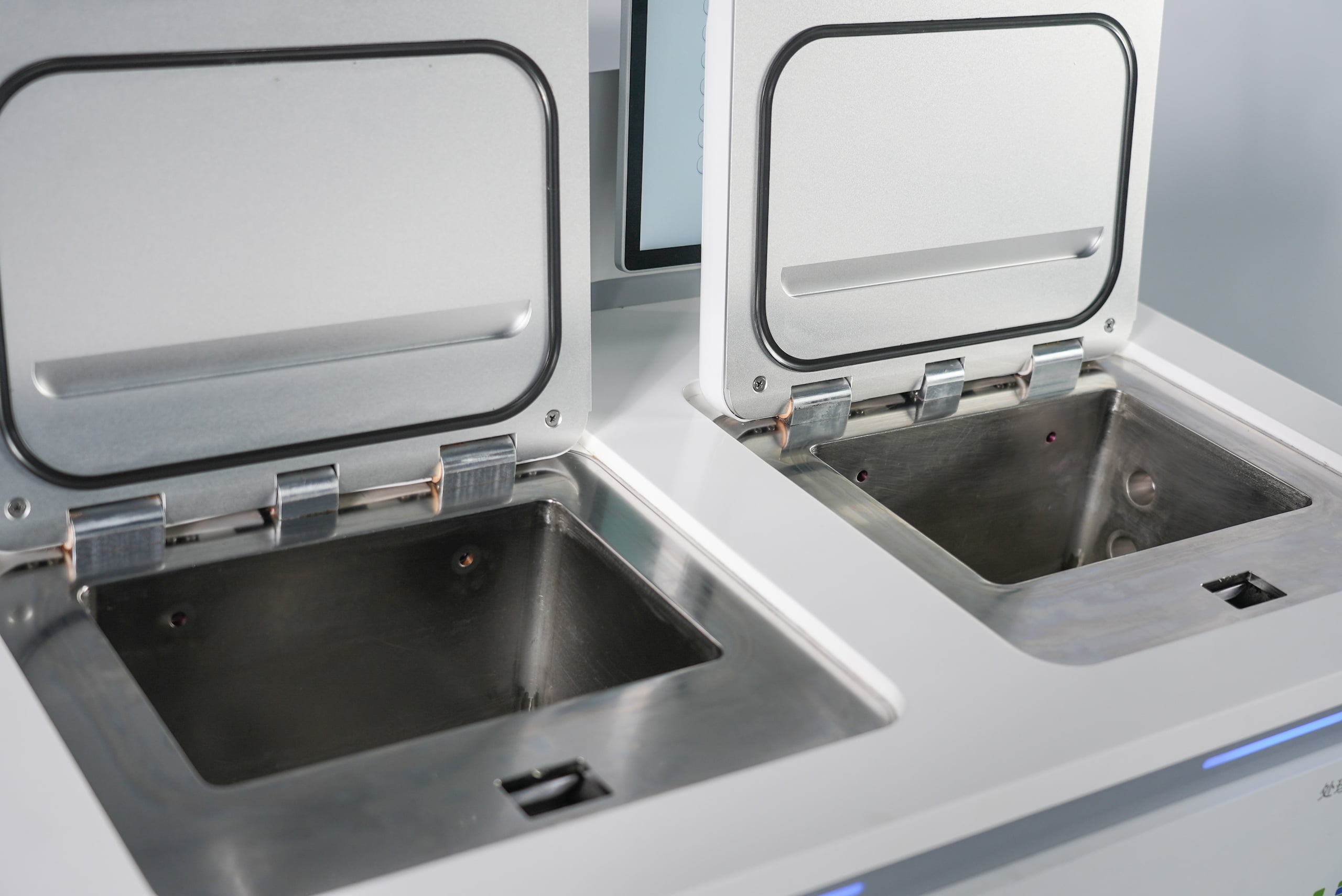
Our enclosed tissue processor line comes in two capacity tiers. The HT-AP-600 here carries 600 cassettes across two retorts; the HT-AP-300 carries 300 in a single retort. Two tiers, because most labs are one or the other — pick with the checklist above.
The dual retort on the 600 answers Mistake 3: one chamber runs the overnight routine while the second takes a short special batch — IHC controls, a decalcification, an urgent case — without stalling the main load.
The delayed-end feature answers Mistake 1. Programs can finish at a chosen time, so the Monday run lands done at 8 a.m., ready for the embedding bench instead of waiting for it. Fifteen validated programs ship on the 15.6-inch touchscreen (13.3 on the 300), and the lab can add its own. A fast program and a slow one side by side — the runs-per-day fix from Mistake 2.
Mistake 5 gets engineered against from the reagent side. The reagent management system tracks concentration, cassettes processed, days, and cycles — the four numbers that actually decide when a bath is spent — with user-programmable thresholds. Chemistry gets changed because it is used up, not because a calendar says so.
Mistake 4, the backup problem, cannot be fully solved by hardware. But an automated tissue processor that sends an SMS to preset numbers and posts status to a web page on fault or power loss collapses the discovery gap from "Monday morning" to "minutes." The 18 reagent bottles plus 4 paraffin stations on the 600 (14 plus 4 on the 300) run on an open rack, and PWM + PID heating holds temperature smoothly at under 2000 W.
The factory background here and the contact form here are where distributors get the sizing worksheets, the spares list, and per-market lead times.
Questions Distributors Ask Me
"Customer asks, 300 or 600? What do I tell them?" Ask two questions back: average blocks per day, and the busiest day last year. If they embed 250 blocks a day on an overnight schedule, the math lands on 600. Under 150, a 300 plus a backup is usually the honest answer. A histopathology device sized to real numbers survives contact with the lab; one sized to a brochure does not. Never size to a number the customer has not looked up.
"The budget only stretches to one machine. What do I advise?" One machine means the backup plan is a neighbor or a fast vendor — make that explicit in writing. A single 600 with a weekend alert beats a 300 pair the lab cannot staff, but only if the alert reaches someone. When you quote a single histology tissue processor, you are also quoting the risk.
"Is the dual retort worth the money?" It earns its keep in two situations: special batches that interrupt the routine, and two techs on two schedules. Neither? A single retort is fine. Either one? The 600 pays for the second chamber inside a year of avoided re-runs.
Technicians in your markets train against frameworks published by bodies like the Institute of Biomedical Science here, and when a tender committee scores IVD hardware, a one-page version of the checklist attached to your bid shows the customer you planned for their workload, not just their budget.
The Size Was Never the Question
That lab manager who did not know her numbers? She checked. The email came the next morning with the LIS report attached — the busiest day was more than double the number in her head. We ran the formula on the phone. The order was for 600. A year later she told me the machine had finished its first Monday run before nine, and nobody could remember the last time blocks waited overnight.
The machine size was never the question. The number was. Get the number right and the machine picks itself.