
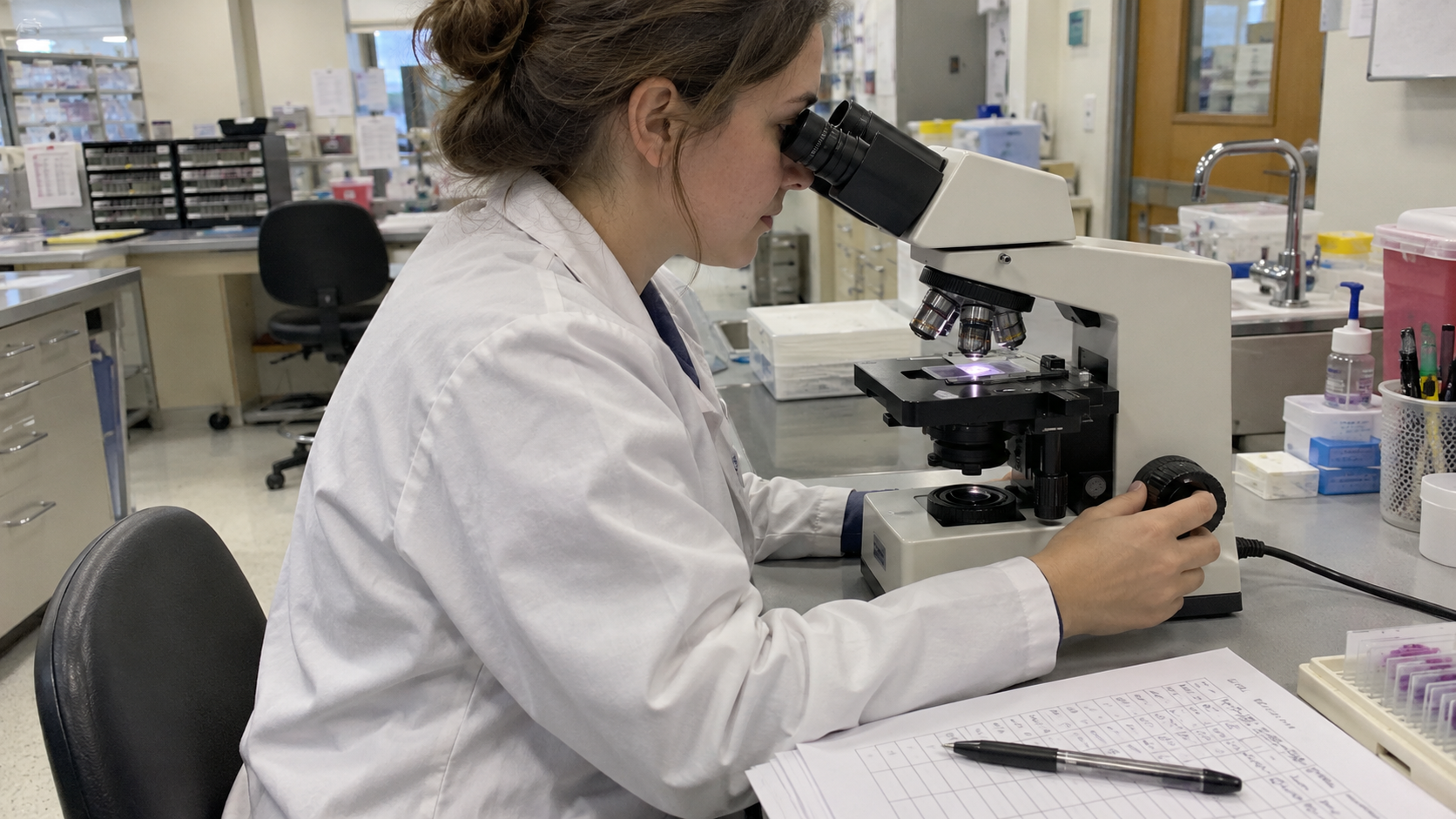
I have sat through a lot of slide stainer demonstrations, and I have also sat with laboratory managers a few months after installation, when the same machine was not doing what the demonstration seemed to promise. The pattern has little to do with brands. The laboratories that end up satisfied are the ones that turned the trial into a test of their own workflow — their slides, their reagents, their people, their busiest afternoon. The ones that regret the purchase usually watched a good demonstration and treated it as evidence.
Shortlisting stainers — which features matter, which capacity class fits — is its own question, covered in how to choose an automated slide stainer. This article is the step after the shortlist: testing a candidate stainer against your own staining workflow, before you sign anything.
A Demonstration Answers a Different Question
A demonstration is honest, but it is rehearsed. The vendor's slides are cut cleanly for that purpose. The reagents are fresh and loaded by someone who does this every week. The operator is the most practiced person the vendor has, and the whole thing runs on a quiet afternoon.
None of that is deceptive — it shows the machine at its best. But it answers one question only: can this stainer work? Your trial has to answer a harder one: does it work on your slides, with your reagents, run by your people, inside your day?
Set the Goal — and the Bar — Before Anything Runs
Before the first slide goes on the machine, write two things down.
The goal. One sentence: what decision will this trial inform, and by when? A trial without a stated goal drifts into a longer version of the demonstration.
The bar. What does an acceptable slide mean in your laboratory — what your pathologists need to see, which artifacts disqualify a slide, and who makes that call. These criteria belong to your laboratory, defined through your own quality system and professional processes; there is no universal threshold a supplier or an article can hand you. For background on how quality management systems frame defined processes and day-to-day laboratory operation, the WHO/CDC/CLSI Laboratory Quality Management System handbook is a useful reference — it does not set acceptance criteria for your slide staining, but it shows the structure a laboratory's own criteria are meant to live in.
If the bar stays vague, every result will pass, because nobody wants to fail their own trial.
Bring Your Own Workload
A stainer tested only on the vendor's material has not really been tested. What I would put on the bench:
- Routine H&E sections cut in your own lab — including the ones that give you trouble: the thin ones, the thick ones, the fatty ones, the large biopsies that barely fit the slide.
- The special stains you actually run every week — not the full brochure list. If you run two special stains a month, bring those two. The goal is to see whether your protocols translate, not to test everything.
- An urgent run — if your lab takes Stat requests. One caution here: confirm with the vendor in advance that the configuration you are ordering supports out-of-schedule runs, and what limitations apply. Do not assume that what the demonstration unit did is what your ordered configuration will do.
- Your own racks and slides — physical compatibility sounds trivial, and it is exactly the kind of thing that gets discovered after delivery instead of before.
- A representative batch — a typical afternoon's workload, not twenty tidy slides.
Ask the vendor in advance what you are allowed to bring. Demonstration units sometimes travel with restricted consumables, and the machine may need cleaning steps between your material and theirs. A vendor who helps you arrange a realistic trial is telling you something useful about how they work after the sale.
The Trial Log: Record Every Batch
Memory is generous to new equipment. After two weeks, nobody remembers whether the second batch on the first day had washed-out nuclei. A log, one line per batch, fixes that:
| What to record | Why it matters |
|---|---|
| Protocol and reagent lots used | Lets you compare batches fairly; a reagent lot change can explain what looks like a machine problem |
| Slides run and slides meeting your criteria | Turns "it looked fine" into a number you can put in front of a committee |
| Total run time and hands-on time | A stainer can be slow but hands-off, or quick but needy; both cost your lab something different |
| Any anomaly, and what was done next | One-off events matter less than patterns across batches |
For the log itself, a simple sheet with these fields covers most trials:
Date:                          Operator:
Protocol name / ID:            Instrument program used:
Sample type(s):                Reagent name(s) and lot number(s):
Slides run:                    Slides meeting your acceptance criteria:
Total run time:                Hands-on time:
Anomaly (if any):              Action taken:
Reviewed by:
Run the trial long enough to cover several days, and make sure at least one of them is a busy day — a calm trial week only tells you how the machine behaves when nothing is going wrong. One caution from the bench: a poor batch is not automatically the stainer's fault. Staining has many inputs — fixation, processing, sectioning, reagent condition — and I have written elsewhere about why Monday morning H&E stains can look wrong when the machine is innocent. The log exists precisely so you can tell those inputs apart instead of guessing.
Let Your Own Operators Drive
During a trial it is easy to watch the vendor's person drive the machine and conclude it is easy to run. Do not watch — drive. Load your own racks, select your own programs, run the cleaning cycle, do the end-of-day steps, and time how long each actually takes.
Then ask the questions that decide whether the machine fits your staffing, not just your bench:
- Who in our lab will own each of these steps, day to day?
- What happens on the day that person is off?
- How long before a new technician can run a full day alone?
- Which steps will get skipped when the afternoon gets busy — and does skipping them cost anything?
Most of the calls I attend after installation are not dramatic chemistry failures. They are routine-fit problems: nobody owns the end-of-day steps, or a cleaning routine takes longer than the method it replaced and quietly stops happening. A trial that includes hands-on operation by your own staff surfaces these before they become habits. Professional bodies take this competency question seriously — the National Society for Histotechnology's training and competency resources are one place to see how labs structure operator training and assessment for histology work.
Reagent Fit: Questions to Answer at the Machine
Reagent compatibility deserves its own session in any trial, because it is where two stainers that look similar on a spec sheet diverge:
- Can it run your reagents? Some stainers accept a wide range of open reagents; others are designed around a defined reagent system. Neither is wrong, but the answer changes your consumables budget and your supplier list.
- Do your protocols fit the reagent layout? Count the positions, check the volumes, and run your longest protocol. A protocol that has to be restructured to fit the machine is a cost the quote will not show.
- How does the stainer track reagent condition? Some track reagent age from slide counts and how long reagents have been in place; others identify reagents electronically. Ask exactly what is monitored, what the machine does with it, and whether you can override it when your own judgment says otherwise.
- What are you locked into? Ask which consumables are exclusive to the system, at what price, with what delivery time. Compatibility is also a supply question.
What a Trial Cannot Verify
A trial, even a good one, runs for days or weeks. You will own the machine for years, and several things sit outside what any trial can measure:
- Service response — how fast the supplier actually comes when a machine is down.
- Spare parts — where they are stocked and how long a wait really looks like.
- Training after the sale — the trial includes a vendor's full attention; the go-live usually does not.
- Consumable supply over years — price stability, minimum orders, local stock.
- Software and protocol life — whether the stainer still supports your work when you add a new stain in three years.
These are answerable, just not by watching a machine run. Ask for reference customers who run a similar volume and put the boring questions to them. Request the documents a buyer is entitled to see: the current specification sheet, service terms, a spare parts list with lead times, the training plan, and the upgrade policy. Structured procurement guidance such as WHO's procurement process resource guide walks through this document trail step by step. Then make sure the contract stage does its part — the checks that belong at delivery are a separate exercise, and what to verify at equipment acceptance before sign-off covers that handover in detail.
Applying the Checklist to the HT-BSHE-660
I work with JunTeng's HT-BSHE-660, so it is worth showing how the questions above map onto one specific stainer. Treat this as a worked example of the method, not as a conclusion: whether it fits your laboratory is decided by your own trial results, not by this section or by the brochure.
Speed. JunTeng's product brochure rates the HT-BSHE-660 at up to 660 slides per hour. As with any rating, the question to ask is what loading that figure assumes. Your log will give you a measured throughput on your own batches — compare against that, not against the rating.
Programs. The brochure lists up to 12 staining protocols running simultaneously. Bring your longest and most awkward protocol to the trial and check whether it fits the machine's structure without being restructured.
Reagent layout. The brochure shows reagent stations that can be configured flexibly, with large and small tanks (750 ml and 260 ml). Map your own tray layout against them during the trial rather than on paper.
Reagent monitoring. The brochure describes RFID-based reagent monitoring and adjustment of staining based on slide count and reagent age, through the stainer's ASBT function. This is a feature worth watching on your own protocols: does the adjustment track what you would have done by hand? Note what it is and is not — it supports the operator's routine; it does not replace anyone's judgment of the slides, and it does not replace pathologist review.
Reagent system. The brochure presents the stainer together with its own H&E reagent kit (mordant, hematoxylin, eosin, differentiator, bluing). Ask directly how your current reagents fit, and what adding a special stain later would involve.
Configuration. Confirm which modes — urgent runs, special stains, connected operation — are supported in the configuration you are actually ordering, since a demonstration unit is not always that configuration.
Documents to request. The current specification sheet, copies of the ISO 9001 and ISO 13485 certificates and CE documentation, and the installation and training materials. JunTeng's full product range carries ISO 9001, ISO 13485 and CE certification, and the certificates are available so you can check their scope yourself before you rely on them in a tender.
The Part You Take Home
A demonstration ends the way demonstrations do: everything worked, everybody was friendly, and the machine looked good. None of that is evidence. The evidence is the folder you carry back — your batches on your slides, your times, your operators' first week with it. Build the trial around that, and whichever stainer you buy, you will know why you bought it.