
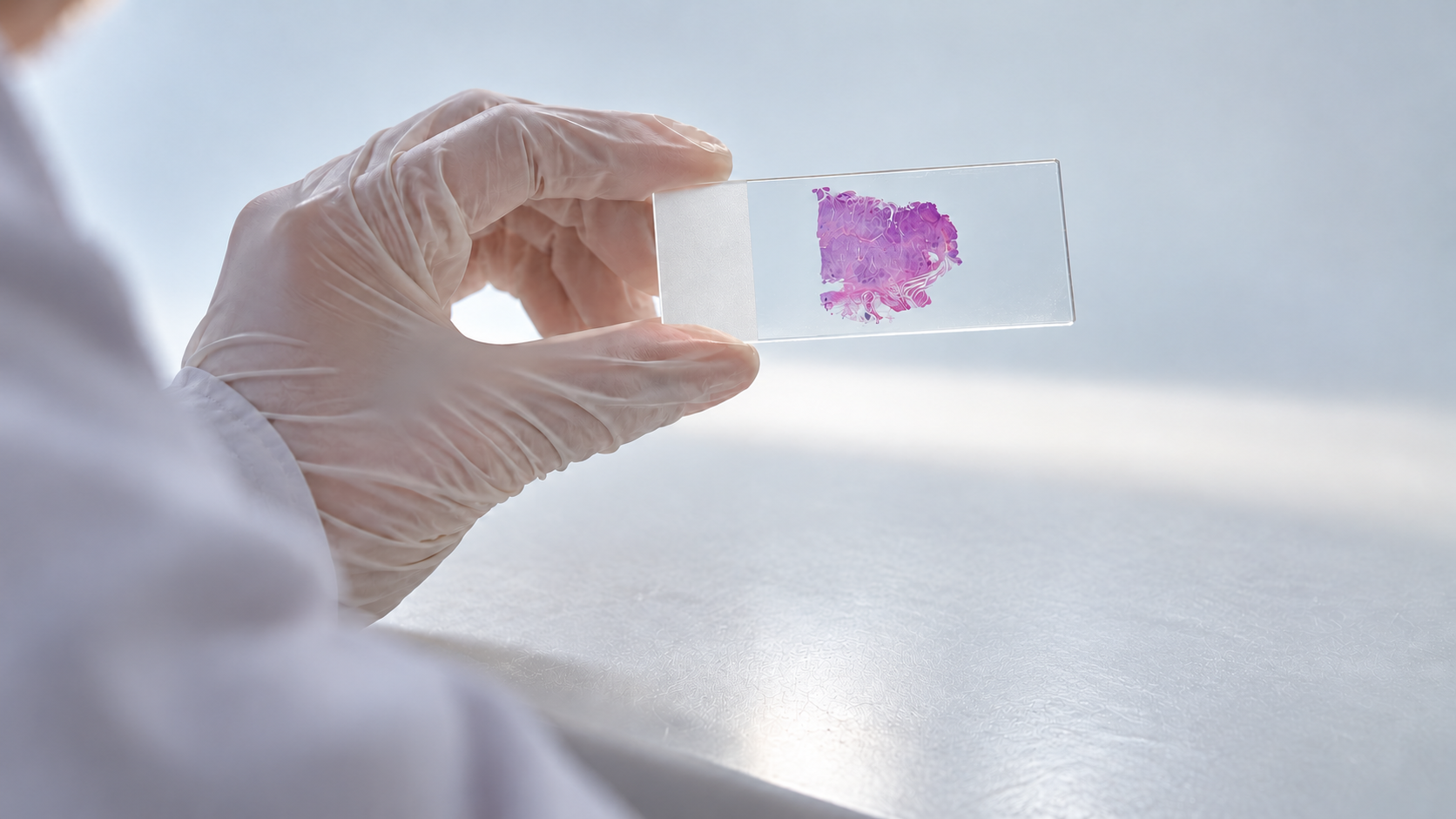
Every histology slide that leaves a laboratory has been covered — either by hand, with a glass coverslip and mounting medium, or by a machine that applies a xylene-activated coverslipping film. Both routes can produce qualified, diagnostic-quality slides. The choice between them is not about which method is better in the abstract; it is about which workflow fits a laboratory's slide volume, its staff, its consumable budget, and its tolerance for each method's specific dependencies.
This article compares the two as workflows: what each involves, where the practical differences appear, how to manage the chemistry safely, and — because brochures are not evidence — a method for comparing both methods fairly inside your own laboratory. It closes with the capabilities to assess in a tape coverslipper before specifying one, where JunTeng equipment fits, and a framework for deciding.
What Manual Coverslipping Involves
Manual coverslipping is a bench skill: apply mounting medium, lower a glass coverslip at the correct angle, let it settle without trapping air, and keep the section centered and streak-free. A practiced technologist produces excellent slides this way. At modest daily volumes, manual work keeps start-up costs low, uses inexpensive glass coverslips, and needs no dedicated machine to clean, maintain, or supply.
The dependencies are human and logistical rather than mechanical. Quality depends on training — and on keeping that training current as staff change. Output depends on how many trained hands are available at the hours when slides actually finish. The failure modes — bubbles, streaks, displaced sections — are the ones described in the glass coverslipping problems I have fixed in real labs, most of which trace to technique or mounting medium rather than to the idea of covering by hand.
None of this makes manual work the weaker option by default. It makes it an option whose main inputs are skilled people and whose consumable supply chain is simple.
What Tape Coverslipping Involves
A coverslipping film is a manufactured consumable — typically a polyester base with an adhesive layer, though formulations vary by supplier, and the product's own SDS rather than any general description is the authority on what a specific film contains and how it activates. The machine feeds a strip of film from a roll, wets or activates it according to the mounting mode, lays it over the slide, presses it with a roller, and cuts it to length. Machines distinguish dry and wet mounting, and the dispensed amount is adjustable within a range the manual defines.
Covering — by either material — exists to protect the section and even out light transmission, and covering artifacts such as bubbles can arise with glass and film alike. An open-access overview of histopathology practice describes this in its section on coverslipping and its artifacts; it is an overview of the artifact, not a head-to-head comparison of the two methods, and it should not be read as one.
The dependencies shift from people to a system: a machine whose daily steps, blade changes and standby behavior are defined in its manual, and a film supply that must match the machine. Both dependencies are manageable; both are real.
Where the Differences Show Up
Consistency. A machine applies the same pressure, strip length and wetting to every slide, so machine-to-machine variation is low by design. Manual work varies with training and technique. Neither statement promises a result: a well-run manual bench can be very consistent, and a poorly maintained tape machine will not be. The useful question is where a laboratory's own variation comes from — and that requires measurement, which the comparison method below provides.
Throughput. Equipment ratings and laboratory output are different numbers. A film coverslipper may carry a rating in the region of 1,000 slides per hour; a rating is a figure measured under the manufacturer's conditions, not a daily guarantee. Actual output depends on loading pattern, batch structure, downtime and the rest of the line. Manual output depends on the operator. The only throughput number worth planning around is the one from the laboratory's own records at its own workload.
Rework. The two methods fail differently. Hand work tends to produce bubbles under or beside the section; film work produces its own patterns when film, blade or alignment are off. Neither is immune; neither is defined by its failure mode.
Solvent handling. Both workflows typically involve xylene-based chemistry, but formulations differ between mounting media and between films — which is a safety-documentation question, taken up below.
Chemical Safety: Read the SDS, Follow Your Own Plan
Coverslipping chemistry should be managed from the safety documentation of the actual products in use, not from general descriptions. Mounting media and coverslipping films are formulated products, and their solvent content differs between brands and products; the same caution applies in both workflows.
For readers who want occupational exposure reference data on the xylene family: NIOSH's pocket guide entry for o-xylene provides occupational hazard information for that specific isomer. Laboratory xylene products are often isomer mixtures in varying proportions, so the entry is a reference point — not a substitute for the SDS of the product actually in use.
Regulatory duties depend on jurisdiction. In the United States, OSHA's laboratory standard, 29 CFR 1910.1450, requires employers using hazardous chemicals in laboratories to maintain a written chemical hygiene plan — a duty that applies to both workflows discussed here. Laboratories in other countries follow their local regulations and their institution's own procedures. In every case, the SDS of the specific reagents and films in use, and the laboratory's own chemical hygiene plan, govern.
How to Compare Fairly in Your Own Laboratory
A fair comparison runs both methods under representative conditions and records what happens. Before starting, define in writing what counts as a qualified slide. Then record:
- Time per qualified slide — from stained slide to finished, accepted coverslip, for each method under the same daily conditions.
- Rework or unsatisfactory rate — counted against the criteria defined in advance, not against impressions after the fact.
- Consumable cost per slide — coverslips and medium on one side, film on the other, at the laboratory's own prices and volumes.
- Training and variation — time to train a new operator, differences between operators, and whether results shift across shifts.
- Workflow impact — downtime, maintenance tasks, and consumable availability: how each method affects the day when something runs out or stops.
Run the comparison long enough to include peak days and, if possible, at least one staff absence. A short trial on a quiet week will flatter whichever method had the better operator that week. The result is data for one laboratory under its own conditions — not a general benchmark — and neither method owes anyone a win.
Consumables: Questions to Ask Any Supplier
The film is not an accessory; it is a running cost and a quality input. These questions work for any supplier's film:
- What are the base material and adhesive, how is the adhesive activated, and where is the SDS?
- Which film widths and cut lengths are validated for the machine in question, and do they match our slides and specimen areas?
- How should rolls be stored, what is the shelf life, and what is the working life of an opened roll?
- How many slides does a roll cover at our volumes, and what does that make the cost per slide?
- How does the machine identify the roll? Some suppliers mark rolls with an identifier such as RFID; others rely on manual selection. The answer affects how settings follow the film.
- What is the minimum order, the lead time, and the local availability? A coverslipper without film is a bench ornament.
Per-slide film cost is higher than glass plus medium — that belongs in the decision, and the real cost of a coverslipper works through the full arithmetic. What this list adds is the rest of the evaluation: a film is only as good as its match to the machine and the supply behind it.
Evaluating a Tape Coverslipper: Capabilities to Assess
When a laboratory reaches the equipment stage, the consumable questions become capability questions. Ask each supplier:
- Film validation. Which films are validated for the machine — tested, not merely compatible — and what is documented about that validation?
- Rated speed conditions. Under what loading and conditions is the rated throughput measured, and what does the manufacturer expect in mixed, real-world use?
- Operator versus service tasks. Which tasks does the manual assign to laboratory staff — daily steps, film changes, waste handling — and which belong to service? Can our own staff perform the operator layer without a call?
- Maintenance documentation. What daily and periodic steps does the manual define, what does upkeep consume, and are error messages documented well enough to describe a fault over the phone?
- Standby behavior. What does the manual require after the machine has been idle? On some machines, for example, the first strips of film after a long standby are sacrificed — and the manual says how many.
- Support. What training and installation are included, what is the spare-parts policy for wear items such as blades, and what is the service response?
These questions are answerable or they are not. A supplier who cannot answer them is describing year three.
JunTeng Equipment in This Comparison
JunTeng's film coverslipper, the HT-FilmC-1000, is documented around the points above. It runs standalone or connected after a stainer; it offers dry and wet mounting with an adjustable drip amount, and its documentation gives different starting settings for the two modes; tape strips are cut in selectable lengths between 45 and 60 mm to match the slide; tape rolls carry RFID identification so the machine knows what is loaded; the documentation specifies blade replacement after roughly ten rolls or when cut quality degrades, defines the daily shutdown steps and the line flush required after a bottle change, and states how the first strips after a long standby are handled; and slides load in 60-slide baskets while finished slides collect in a 240-slide unload carousel. Its throughput rating is around 1,000 slides per hour — and as with any rating, the question to ask is what loading that figure assumes.
In the connected configuration, the coverslipper runs after JunTeng's HT-BSHE-660 stainer, which carries RFID-tagged reagent bottles and tracks reagent status from slide counts and time in place, and whose ASBT function recalculates H&E staining times from that status during the run. On the ratings, the coverslipper's 1,000 slides per hour runs ahead of the stainer's 660 — deliberate headroom, so coverslipping does not become the bottleneck behind staining. Whether the connected line or a standalone coverslipper suits a laboratory depends on its volume and on what happens between staining and covering — the integrated staining and coverslipping workflow article covers that arrangement in detail.
JunTeng Medical's full product range carries ISO 9001, ISO 13485 and CE certification. Current specifications for both machines belong in a quotation conversation — confirm them with the manufacturer, and hold any equipment to the evaluation questions above. The JunTeng integrated staining and coverslipping system page is a starting point for those conversations.
A Decision Framework
Neither method wins on paper; each wins under particular conditions.
Manual coverslipping remains a sound choice when daily volumes are modest, trained staff are available when slides finish, turnaround is comfortable, and the laboratory's own records show low rework against its defined criteria. If the fair comparison above confirms this, there is no problem to solve.
Evaluating a tape coverslipper is worthwhile when slide volume or end-of-day peaks strain turnaround, when rework or operator-to-operator variation shows up in the laboratory's own counts, when trained coverage is thin at the hours that matter, or when a connected stain-to-cover workflow would remove a handled step entirely.
Either way, the method is the same: define the criteria first, record the laboratory's own numbers, and let those numbers — not a brochure, and not an anecdote — carry the choice.