
Two Hours In, She Had Not Asked to See a Machine
The assessor had been in the laboratory for two hours and had not asked to look at a single instrument. She was standing at the bench where the identification records live — the accession log, the block list, the slide list — turning pages with one finger, stopping where the writing thinned out. One accession number had been entered twice: the first struck through, the second squeezed into the margin beside it. Then came the question I have heard in every assessment I have sat through: show me how a correction is made, and where it is recorded.
Nothing was wrong with the work that day. What was being tested was not the stain or the protocol, but whether an identifier can be followed from the patient to the slide and back.
Why Identification Comes Up So Often
A specimen identity is a chain: patient, request, container, cassette, block, slide, report, and every hand-off has to lead back to the same person. Other failures announce themselves — a bad stain shows in the morphology. A broken identity does not. The section looks correct; only the link is wrong.
That is why identification sits on two lines at once. On the patient-safety line, connecting a result to a person is written into regulation. For laboratories working under CLIA, a test request has to carry the patient's name or unique patient identifier; patient-safety goals in the same market ask for at least two identifiers when specimens are collected for clinical testing, and for containers to be labelled in the presence of the patient (NPSG.01.01.01).
Laboratory accreditation specimen identification requirements ask for something narrower, and they apply to the laboratories accredited to them: the sample has to be traceable to a uniquely identified patient by request and by labelling, and every portion has to remain traceable to the original. ISO 15189:2022 addresses this through its sample-receipt requirements (7.2.6) and its labelling requirements (7.2.4.2), which reach down to multiple pieces of tissue or slides from one patient.
One defect is then assessed twice: as a safety event, and as a gap in process control.
What the Assessor Is Actually Looking At
Histopathology specimen labeling requirements come down to five checkpoints, in roughly this order.
Does the identifier survive the process? The mark is made before xylene, alcohol and heat, and read afterwards. If it cannot be read at the point of use, everything downstream is a reconstruction.
Is there a numbering rule? Unique within the laboratory's own identification system, under a documented rule, and applied the same way on cassette, block, slide and report.
Are corrections recorded? A controlled correction stays traceable — what was changed, who changed it, when, and why — under the laboratory's own procedure. An obliterated number is a gap, even when the corrected value is obviously right.
Where is the identifier re-keyed? Every re-entry point is a place where a check can exist, or cannot. The count matters more than the method.
Can the chain be walked backwards? Take a slide from the archive and trace it to the patient without the person who cut it.
Each checkpoint is settled by a different piece of evidence.
| Checkpoint | The question behind it | Evidence that answers it |
|---|---|---|
| Legibility after processing | Does the mark outlive xylene, alcohol, heat and storage? | Slides and blocks pulled at random, not a prepared sample |
| Numbering rule | Is every identifier unique, under the laboratory's documented rule? | The written rule, plus two or three cases traced end to end |
| Corrections | What was changed, who changed it, when, and why? | The laboratory's own procedure, applied to a worked example |
| Re-entry points | How many times is this identifier typed again? | The workflow, walked step by step at the bench |
| Reverse traceability | Can a slide reach the patient without memory? | One archived slide, followed to the report and back |
Nothing in that table depends on how the identifier was produced.
The Weak Point Is Not the Person
I am not going to argue that hand-written identifiers are careless, because they are not. In a small laboratory with a stable team, a marker and a steady hand work, and have worked for a long time.
The weakness is structural. Between the hand that writes the number and the eye that reads it, there is no check. The identifier has no way of disagreeing with itself.
A machine-readable identifier differs in kind, not only in speed. It can be checked automatically against a digital record, so a mismatch can surface at the point of use instead of later. Where the laboratory's own software records user actions and timestamps, those records can become part of the traceability chain, rather than depending on notes written up afterwards.
Published experience points the same way. A study in the American Journal of Clinical Pathology (2021) describes a laboratory where block scanning was available but optional, and could be bypassed. Making the confirmation step mandatory did not move the rate; only when it became a hard stop did wrong-tissue-in-block events fall from 0.043% to 0.005%. The scanner was not the fix on its own; the check point was. An earlier histology study by Heher et al. reported labelling errors falling from 1.03% to 0.28% after a barcode-enabled laboratory information system.
None of this makes printing mandatory. A low-volume laboratory can hold the chain together by hand; the question is what the chain rests on. Five close calls from the bench covers what happens when a link breaks.
From Requirement to Capability
Five questions separate one offer from another when a laboratory writes its slide cassette labeling compliance requirements. They are also questions a lab rarely sees on a quote.
1. Does the identifier go onto the carrier itself, or onto something applied to it? A mark in the cassette or the slide is part of the object. A label is a second component with its own failure modes and its own supply.
2. Can it be read by a machine, and does the read leave a record? Reading is where a check becomes possible. A scan that produces no record adds speed and nothing else.
3. Does the marking system talk to the LIS? If the code on the plastic and the code in the system come from one source, the relevant manual re-entry step can be removed or reduced rather than managed.
4. Does it work at both ends of the workflow? Batch capacity for scheduled work, and single-piece printing at the bench when one block arrives late.
5. What does it consume, and for how long? Printing consumables — ink, ribbon, labels, print heads — are a ten-year line item, supplied by whoever sold the machine.
Six items worth having ready before an assessment.
| Before an assessment, be able to show | What it proves |
|---|---|
| The numbering rule, in writing | That the scheme is a system, not a habit |
| One case traced from request to report | That the chain holds end to end |
| One archived slide traced back | That it holds without the original staff |
| The correction procedure, with an example | That a change is recorded, not just made |
| The points where identifiers are re-keyed | Where transcription risk sits |
| What the mark is made of, and what it resists | Whether the identifier is durable, not only legible |
What JunTeng Builds for This
Five questions, five answers.
On the carrier itself. The UV laser marks the cassette directly, with no ink and no ribbon. The marking is designed to remain readable through routine histology reagents such as xylene, and cassette samples can be tested before a bulk order.
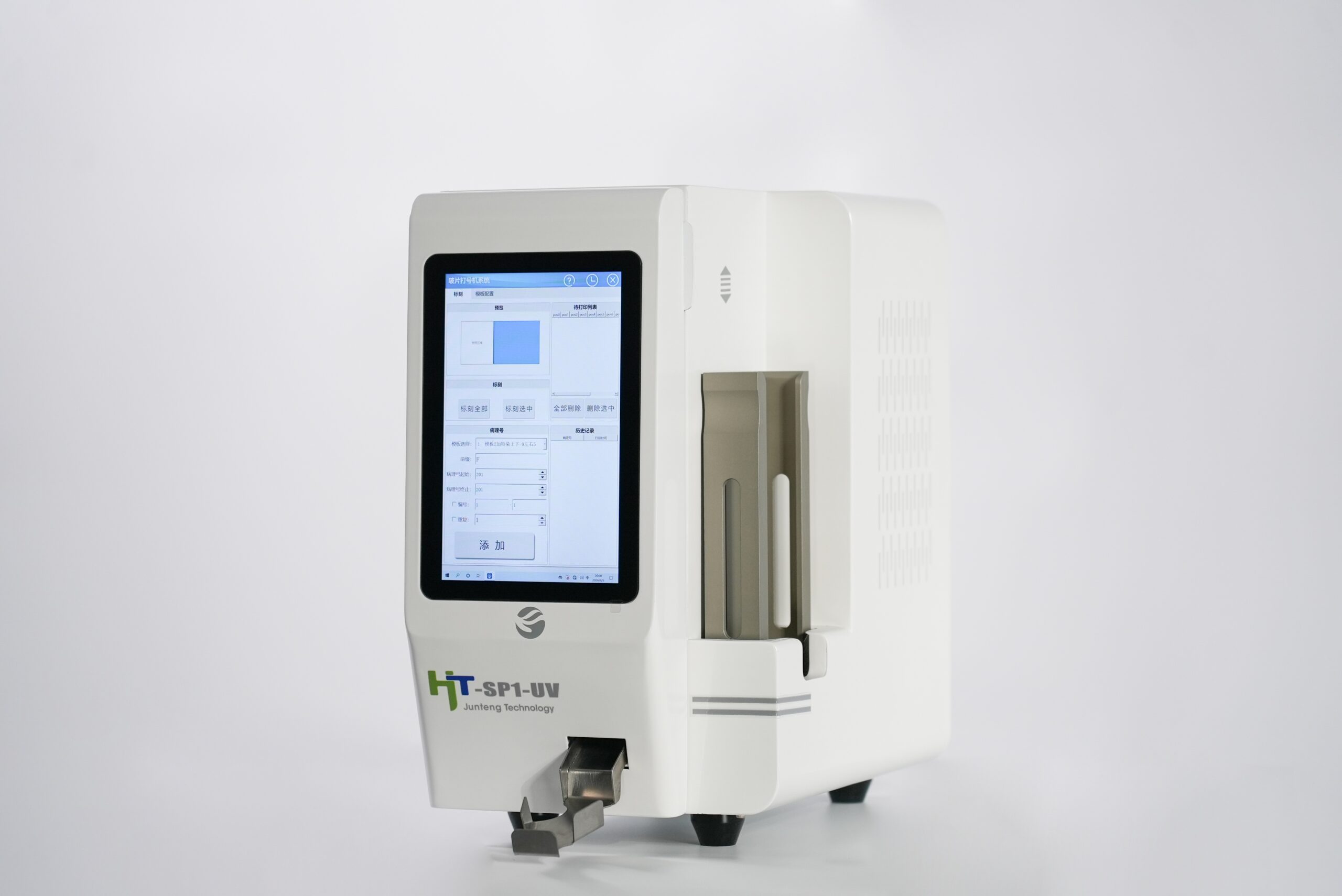
Machine-readable. The software supports 2D codes. HT-SP1-UV reads the code on the cassette and prints the matching slide information, so the identifier carries across by a scan, not by a person re-typing it.
Connected to the record. The in-house software integrates with hospital LIS/QMS systems and handles multi-language text, symbols, graphics and 2D codes, with custom data entry and batch release QC. Batch release is one place a recorded check can sit; whether a laboratory uses it that way is its decision, not a property of the machine.
Both ends of the day. Scheduled batches and late single blocks are two different jobs. HT-CP1 takes up to 160 cassettes for bench-side work. HT-CP10 takes up to 600 (6 × 100), with automatic loading, for the scheduled run. Both mark at ≤3 seconds per unit and cover hinged, assembled and open cassettes. For the single piece, HT-SP1-UV has a 150-slide removable external loading bay, releases output in batches of 1, 10 or 150, and takes LPA, non-LPA and IHC slides.
Consumables. There are no printing consumables to replace: no ink and no ribbon — the line worth pricing before the purchase rather than after it.
The rest of the specification — dimensions, weight, the air filter, the safety interlock — belongs on the product page. The full cassette printer range is here.
Two things this does not do: it does not make a laboratory compliant or decide an assessment. Accreditation is the laboratory's own responsibility, judged on its records, not on the equipment in the room. Company certification and the CE documents for the equipment lines are published in full here, so a tender file can be checked against the original documents.
Two Questions Distributors Ask
"How do I use this with a laboratory?" Ask them to take one slide out of the archive and trace it back to the patient. If they can do it from records, they are in good shape. If they have to remember, the conversation has started itself.
"How should identification be written into a tender?" As a performance requirement, not a model number: the identifier is created where the work happens, is machine-readable, links to the patient record without re-keying, and survives the reagents used in processing. The file that goes with it also needs the manufacturer's side — what the factory covers and what support comes with it — so the requirement is scored on evidence, not adjectives.
A hand-written number is not a mistake, and a printed one is not a certificate. An assessor is looking for whether the identifier can be tested by somebody other than the person who wrote it. If you are writing that requirement now, we can work through it with you.