
The Morning Review
It was the morning quality-control meeting, and two slides sat side by side on the light box. Same fixative, same stain — and only one label left between them. Somewhere in the staining line the other label had lifted, drifted, and re-stuck on its neighbour. Two patients. One label. Nobody could say which section belonged to whom. Then the phone rang: a nurse asking whether yesterday's biopsy result was correct. That is the call every lab hopes never to take.
No misdiagnosis that day — the case was re-cut, re-stained, corrected, signed out late. But it began with a patient's identity carried, for one hour, by a label never meant to move.
Why This Is the Highest-Risk Link
A specimen is a chain: patient, container, cassette, block, slide, report. Break any link and the chain is dead. A failed stain shows up in the morphology; a broken identity does not. The section looks perfect; only the name is wrong.
The published numbers agree. A College of American Pathologists study of 136 institutions measured mislabeling at 1.7 blocks and 1.1 slides per 1,000 (Nakhleh et al., Arch Pathol Lab Med 2011). An analysis of 227 root-cause reports in the Veterans Health Administration put specimen mislabeling at roughly 0.1% of specimens, with consequences from repeat biopsy to surgery that should never have happened (Dunn & Moga, Arch Pathol Lab Med 2010). Histopathology labeling errors are common enough to be studied, serious enough that one case ends a career.
When the processor fails at 2 a.m., you can sometimes salvage the run. When the identity of a block is lost, you cannot salvage the patient's certainty. Here are five near-misses I have seen, with the rule that stops each one coming back.
One: The Wrong Number on the Right Block
Symptom. A block from patient A carries patient B's case number — or two blocks in one accession wear the same number, which is how the embedding technician caught it.
Root cause. Batching — two cases open at once, similar numbers, one hand writing both. The VHA analysis names batching among the most common causes of misidentification.
Salvage rule. If the tissue types differ, compare contents against the dictated description and re-identify. If the tissue is identical and you cannot tell which block came from which patient, stop and treat the identity as lost.
Prevention. Never write a case number from memory. Print the cassette at the moment of grossing, from the LIS, so the code on the plastic is the same code in the system.
Two: The Number That Faded in Xylene
Symptom. After processing, the marks on a batch of blocks are pale, smeared, or gone — ribbon-printed and inkjet numbers fail first. You notice at the microtome, picking up a block you cannot read, or months later on the archive shelf, when the number has faded to nothing.
Root cause. Xylene and strong alcohols attack ordinary inks. Published chemical-resistance data rate standard inkjet ink as poor in xylene — it smears or lifts, and the mark can be gone after one cycle. In my experience, ribbon-printed numbers fail the same way when the ribbon is cheap or the head pressure is low.
Salvage rule. If run position, the block list, and the gross description let you place it, re-mark before sectioning. If you cannot place it, it is the unrecoverable case.
Prevention. A mark that survives the solvents it will meet. That is the whole test: what happens to this identifier after xylene, alcohol, and a year on a shelf?
Three: The Code That Would Not Scan
Symptom. The scanner beeps an error, again and again, until the operator types the number in by hand. It happens at the slide-printer station, where the workflow depends on a clean read.
Root cause. Print quality and media. Inkjet codes smear, light codes lack contrast, and adhesive labels pick up solvent. Even mature barcode systems log manual entries — in one hospital's transfusion tracking, three to seven percent of scans were aborted or entered manually (AHRQ report). Every manual entry is a transcription risk wearing a different coat.
Salvage rule. Manual entry is allowed, but it is a two-person job: one reads, one verifies, both sign. Log every manual entry — a rising count means the codes are failing, not the people.
Prevention. Codes printed at high contrast and verified after printing. A code you cannot read is a code you should not have accepted.
Four: Two Patients, One Name, One Birthday
Symptom. Two patients with the same name and date of birth, both in the same day's batch — and their blocks look identical.
How we found it. At accession, a careful clerk caught the duplicate and stopped the case — the kind of catch that gets no credit.
Root cause. Homonymy is not rare. In a Texas hospital district database of 3.4 million patients, 7.3% shared a full name and 2.0% shared a name and date of birth; among patients named Maria Garcia, 9.3% also shared a birthday (J Med Biochem 2017). When two such patients meet in the same accession, the name on the cassette cannot tell them apart.
Salvage rule. Never resolve by assumption. Pull a third identifier — medical record number, address — and verify before touching tissue. If both cases are already cut and the tissue is identical, you may not be able to prove which is which — the unrecoverable case.
Prevention. The identifier should be a machine-readable case ID tied to the LIS — not a name that two patients share. Patient identification in laboratory medicine always comes back to two identifiers, and a system that checks them.
Five: The Block That Came Out Blank
Symptom. A cassette comes out of the processor with nothing readable on its writing face. The number went in by hand; it comes out pale, smeared, or gone — and on a blank cassette, every block looks like every other block.
How we found it. At embedding, when you pick it up and there is nothing to read. You check the whole basket — one blank or several?
Root cause. A cassette is written on with a marker because a label would not survive the process — the marker is the weak point moved, not removed. Ordinary marker ink dissolves or fades in xylene and strong alcohol, and even a solvent-rated pen fades faster in hot programs and long cycles. The mark can also fail before processing starts: a smudged digit on smooth plastic, a line skipped on wet surfaces, a number pressed too lightly to last. In my experience, the blank cassette almost always begins as handwriting.
Salvage rule. If it is the only blank, the run order is known, and the gross description places it, reconstruct and re-mark. If there are several blanks, or the run was interrupted, do not guess — the identity is lost.
Prevention. Put the mark into the plastic, not onto it. Laser marking changes the cassette surface itself — no ink layer for a solvent to remove, no written line for a glove to smudge. The identifier stops being a coating and becomes part of the block.
The One Rule That Has No Salvage
Four of these five near-misses have a salvage path. The fifth does not. When a block's identity is completely gone — no number, no code, no way to prove which patient — no re-mark, re-stain, or re-cut brings it back. The only honest outcome is to discard and re-gross, or re-biopsy — a cost the patient pays, not the marker.
Specimen misidentification is the one error with no salvage rule, only prevention rules. That is why tolerance for it has to be zero — exactly what people cannot deliver on a busy bench at five in the afternoon. The tolerance has to be built into the equipment.
What We Verify Before a Printer Leaves Our Factory
The five root causes above are the checks our printers pass before shipping — we test for the failure you just read about.
Fading (accident two). Our marking is UV laser marking, contactless, with no ink and no ribbon to fade. The mark is made into the surface of the plastic, and it resists xylene, alcohol, and the common reagents — we verify this, because a printer that produces a number that disappears after one cycle has failed its only job.
Scan failures (accident three). Our 2D codes are printed at high contrast, and the software runs a batch-release quality check, so codes leave the machine only when they are readable.
Transcription (accident one). The slide printer reads the cassette's own code and prints the matching slide information — the identifier transfers by scan, never by retype. The hidden cost of handwritten specimen IDs is exactly what this removes.
Identity at the source (accident four). The software is self-developed and integrates with hospital LIS and QMS systems, so identity is checked where the case is created, not re-typed at the bench. It handles multi-language text, symbols, graphics, and 2D codes, with PC, touchscreen, or scanner input.
Blank blocks (accident five). A laser mark is not handwriting. There is no ink layer for a solvent to dissolve and no written line for a glove to smudge — the identifier is part of the cassette, which is why it is still readable when the cassette comes out of the processor.
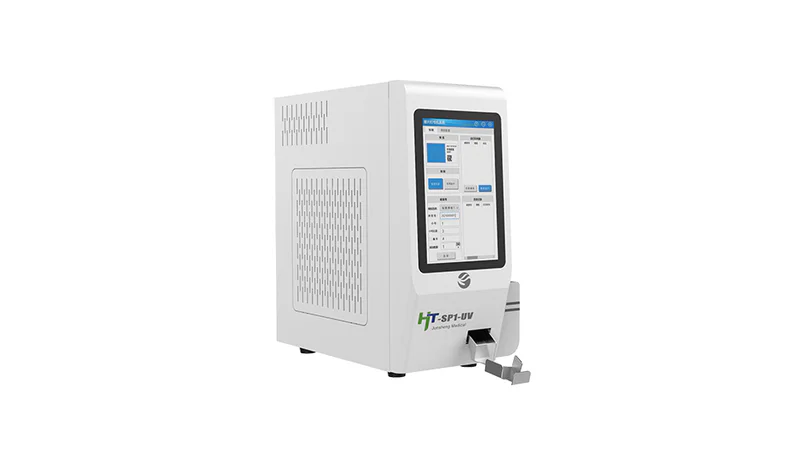
The hardware is modest: the HT-CP1 tissue cassette printer holds up to 160 cassettes (335×485×455 mm, USB); the HT-CP10 holds up to 600 (6×100) with auto-loading and automatic six-color cassette selection (450×455×420 mm); the HT-SP1-UV slide printer takes a removable 150-slide magazine, outputs in batches of 1, 10, or 150, reads the cassette's QR code, and runs on an 8-inch touchscreen with Ethernet and USB, under 15 kg, with internal air filtration and a safety cover that stops on opening. Marking speed is under three seconds per piece. The units are CE safety certified; the company holds ISO 9001 and ISO 13485. Specifications: HT-CP1, HT-CP10, HT-SP1-UV
"What do I say when a lab asks why it needs one?" Start with the morning review and the phone call. The buyer is the pathologist or lab manager who signs the quality checklist, not the person who runs the processor. This is a risk-avoidance sale: the pitch is the two slides on the light box, not slides per hour.
"What do I write into a tender?" Put the identity chain into the technical requirements: automatic marking with machine-readable 2D codes, interface with the LIS, scan-to-print verification, and print-quality batch release. Those four lines turn a hardware bid into a quality-systems bid, and they are the same four checks this article is about. Talk to JunTeng about distributor pricing and tender documents.
Back at the Light Box
The case was saved that morning. But the question stayed with me: what had been carrying that patient's identity, and how easily had it come off?
It should not be that easy. A block's identity should not depend on a marker that washes off in processing; a slide's identity should not depend on a label that lifts in the staining line; neither should depend on a tired person at five in the afternoon. The glass slides that went wrong before and the stain that failed on Monday could both be traced back and fixed. A lost identity cannot — it is the one failure worth building out of the workflow.
Histopathology is a chain of hand-offs, and every hand-off is a chance for the chain to break. Make the links that carry identity as unbreakable as the ones that carry reagents — and the only handwriting left in the lab signs out reports, not blocks.