
It is five in the afternoon, and the grossing bench is three trays deep. The technician's gloves are wet with formalin. She picks up a cassette and a marker and writes the accession number by hand. The plastic is smooth, and the ink skips twice. She slows down, writes it again, checks it, and moves on to the next one. Forty more before the processor run can start.
Nobody budgets for this. It is not in the equipment plan, not in the reagent line, not in any tender I have ever read. It is the cheapest patient-safety upgrade in the building, and it has no line item at all.
What a Cassette Printer Actually Does
A cassette printer puts a permanent identifier on the cassette at the grossing bench, before the tissue goes into the processor. A slide printer does the same job at the microtome, after the section is cut. Two machines, two breakpoints in the workflow. The histopathology workflow, from grossing to slide, is a long chain of hand-offs, and every hand-off is a place where an identifier can go wrong.
The mark itself has to survive three environments: the solvents in the processor, the heat of embedding, and the archive shelf. If it fades at any one of those points, the chain breaks — usually silently, and usually long after anyone could fix it. After embedding, that identifier is set for the life of the case.
Two mistakes come up in every conversation. First: "just get an inkjet." An office inkjet prints onto a label, and the label then has to survive a processor full of xylene and alcohol. The label industry's own chemical-resistance charts — Brady's and LabTAG's, to name two — show that standard inkjet print smears or fades in xylene. The versions that survive are coated specialty media, priced as ongoing consumables, with rated immersion times in minutes. And a sticker is a second failure point: in my experience, the adhesive lets go inside the processor more often than anyone admits, and a cassette loses its name mid-run.
Second: "one printer does the whole lab." It does not. Cassettes are marked at grossing, slides are marked at cutting, and the two stations are often in different rooms. Why you should price the tape before you buy a coverslipper covers what happens to the slide downstream; it still has to be identifiable before it ever gets there.
Hand-Written vs Inkjet vs UV Laser
Run any marking method through four columns. The table is short, and it settles most of the argument.
| Hand-written | Inkjet label | UV laser marking | |
|---|---|---|---|
| Durability | Ink skips on wet plastic; marker fades in xylene and alcohol baths | Standard ink smears or fades; needs coated specialty media | Marked into the cassette surface; resists xylene, alcohol and common reagents; no fading |
| Running cost | Marker is cheap; the cost of errors and rework is invisible | Cartridges and label stock, forever | No ink, no ribbon, no labels; zero consumable cost |
| Speed | A few cassettes a minute, legibility varies by person | About three seconds per label, then peel and place | ≤3 seconds per cassette or slide, hands-free |
| Traceability | Depends on the handwriting; nothing machine-readable | Codes are possible, but media-dependent | 2D codes, LIS/QMS integration, batch release QC |
Use the same four columns on any quote. The columns are the evaluation, whatever the badge on the machine says. When the running-cost column comes up, the ten-year ledger of a tissue processor is the read that shows how consumables quietly dominate a machine's real cost.
What One Mislabeled Block Costs
Now the arithmetic. The errors are not hypothetical.
A College of American Pathologists Q-Probes study across 136 institutions, published in the Archives of Pathology & Laboratory Medicine (2011), measured 1.7 mislabeled blocks and 1.1 mislabeled slides per 1,000. Nearly a third of all mislabeling events happened at tissue cutting — the step where slides get their identifiers — and one in five happened at block labeling. In 1.3% of mislabeling events, patient care was affected.
Put that rate on a real bench. A lab that embeds 100 blocks a day runs about 25,000 blocks a year. At 1.7 per 1,000, that is more than 40 blocks a year carrying a wrong identifier at some point in the chain. Most get caught — the study found 96.7% were corrected before the report went out. "Most" is not the standard. The same study noted that most errors were caught one step after they happened — by the next pair of hands, not by any system.
The direction of the fix is well documented. A CDC-commissioned systematic review and meta-analysis (Snyder et al., Clinical Biochemistry, 2012) found manual entry about 4.4 times more likely to produce identification errors than barcode systems. A published study at a pediatric hospital (Zandieh et al., The Journal of Pediatrics, 2008) saw mislabeled specimens drop from 0.032% to 0.005% after bar-coding — an 84% reduction.
Then price the consequence. A mislabeled block can mean a repeat biopsy: the patient goes back for another procedure, the diagnosis is delayed, the case gets reviewed, the lab answers questions, and the department's reputation takes the hit. A slide with the wrong name can land in the wrong report. None of that has a price ceiling, and all of it can be set off by a marker that costs a dollar.
The numbers above come from published laboratory studies, not from a sales brochure. The logic holds for every cassette that enters a processor, whatever the badge on the door.
The printer is a one-time capital purchase. It removes exactly the variable the published data say is weakest: the hand-written identifier that depends on a tired technician at five in the afternoon. Accurate histopathology specimen identification is a stated patient-safety priority of the College of American Pathologists and the Joint Commission, for the same reason. How big a tissue processor does your lab really need covers the machine the blocks flow into; the identifier travels with the block the whole way, and it is only as good as the marking step that starts it. A laboratory information system is the other half: the identifier is only useful if the system can read it and pass it on.
If It Were My Own Lab
Honest concession first. At a few cassettes a day, a marker is fine. I have told lab managers this and I mean it. Handwriting still works when the volume is small, the staff is stable, and the two-person check actually happens. Do not buy a printer to fix a process that does not need one.
Past that, the decision is about volume, not brand.
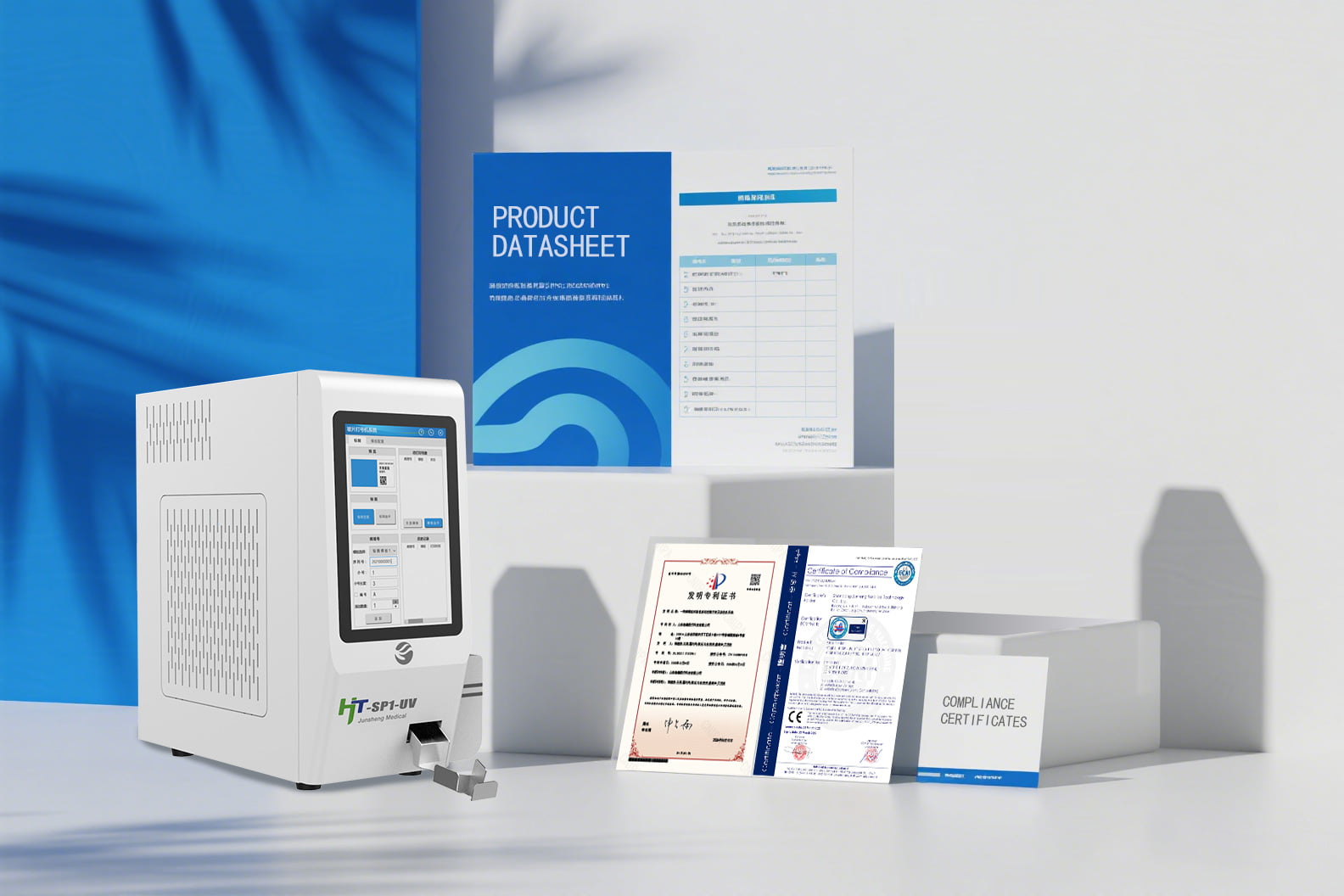
Low volume: a compact cassette printer at grossing, a compact slide printer at the microtome. Print on demand, where the work happens — the HT-CP1 and the HT-SP1-UV.
High volume: auto-loading and six cassette colors, so the cassette itself carries a code and the morning's output sorts at a glance. When racks of blocks leave before noon, you want a hopper that holds the day's work — the HT-CP10. The automatic staining and coverslipping workstation shows where the slides go next; the line works end-to-end only if every piece is identifiable at every step.
The JunTeng Line, Measured Against the Four Columns
Run the four columns from the table against the JunTeng printers, because that is exactly what I would do with any vendor.
Durability. Contactless UV laser marking — no ink, no ribbon. Resists xylene, alcohol and common reagents; does not fade. No burning, no surface deformation, no heat damage, no fumes.
Running cost. Zero consumables. Zero operating cost for the mark.
Speed. ≤3 seconds per cassette or slide.
Traceability. Self-developed software integrates with LIS/QMS: multi-language text, symbols, graphics, 2D codes; PC or touchscreen input; custom entry and batch release QC. Scan-to-print reads the cassette QR code and prints the matching slide info.
The models: HT-CP1, compact, up to 160 cassettes (335×485×455 mm, USB); HT-CP10, up to 600 cassettes (6×100) with auto-loading and automatic six-color selection (450×455×420 mm); HT-SP1-UV slide printer: removable 150-slide magazine, batch output 1/10/150, 8-inch touchscreen, Ethernet and USB, under 15 kg, internal air filtration, safety cover warns and stops if opened. It handles LPA, non-LPA and IHC slides. CE safety certified; ISO 9001 and ISO 13485. Specifications: HT-CP1, HT-CP10 and HT-SP1-UV.
Questions Distributors Ask Me
"How do I sell this?" Lead with risk, not throughput. The buyer is the pathologist or lab manager who signs the safety checklist, not the person who runs the processor. Walk in with the CAP number — 1.7 blocks per 1,000 — and the traceability story. No reagents, no installation drama, no workflow change: the lowest-barrier entry in the catalog.
"What goes into a tender?" Put the integration into the technical specification: automatic marking with machine-readable 2D codes, interfaced with the LIS, with batch release QC. That wording turns a hardware bid into a quality-systems bid. Talk to JunTeng about distributor pricing and tender documents.
Back at the Bench, at Five in the Afternoon
The technician is still there, and the marker still skips on wet plastic. The difference is what the lab chose to rely on: a dollar marker and a tired hand, or a mark that xylene cannot wash off. The upgrade does not ask for a bigger room, a new reagent, or retraining. It asks for a budget line. The cheapest patient-safety upgrade in the building is also the easiest one to budget for — once someone puts it in the plan.