
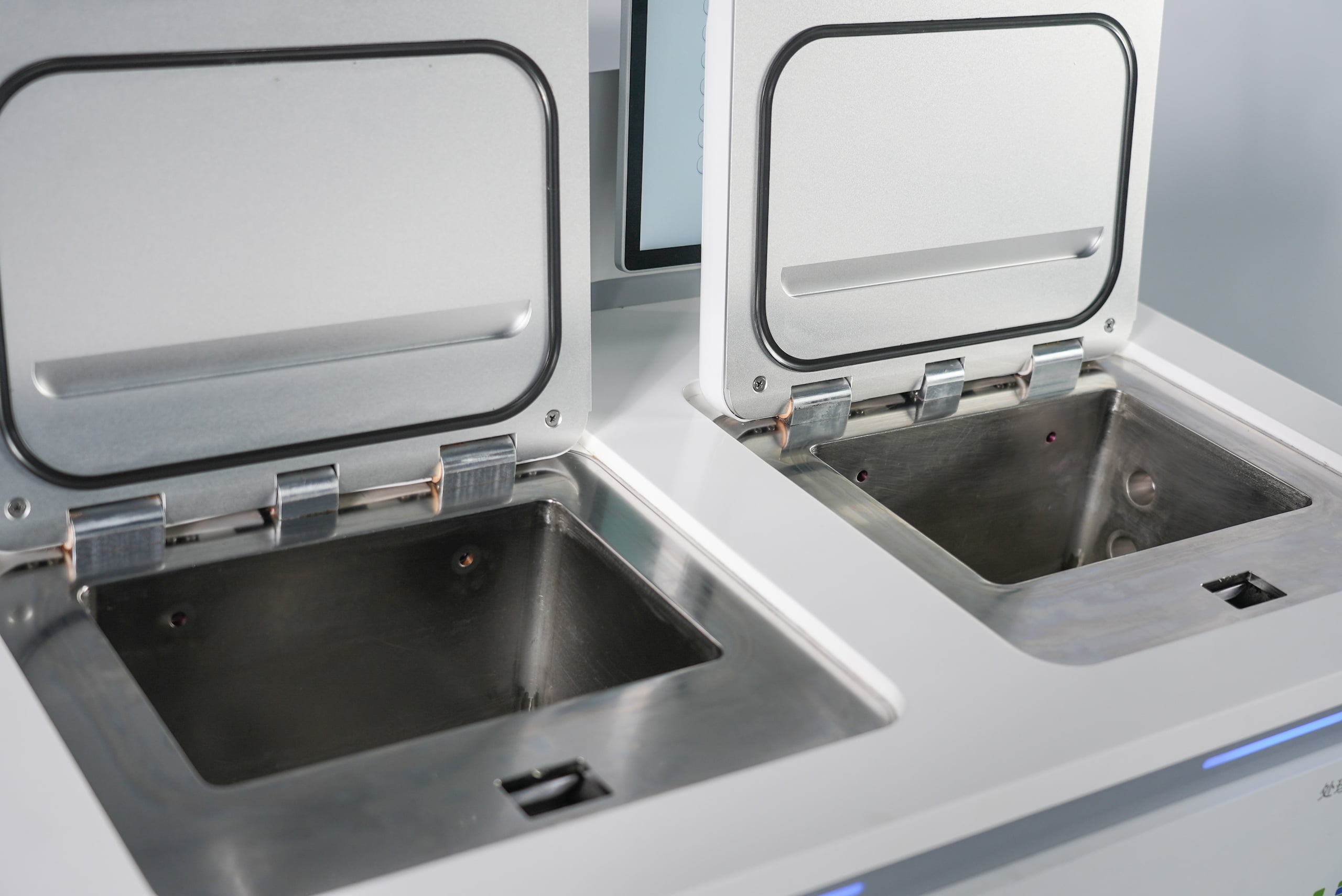
The retort lid came off with a crack of old wax. Inside was the story of ten years: paraffin grown into grey crystals on the walls, white grit packed hard into the intake lines, a gasket that had stopped sealing years ago. The processor still ran, and the lab signed out slides every morning. But every complaint in that department — brittle fatty cores, blocks that crumbled at the microtome, a pink haze at the edges of sections — was written on the inside of that chamber.
That is the part of the machine nobody asks about. Buyers compare capacity, bottle counts, touchscreen sizes. The retort is the only component of a tissue processor that ever touches your specimens, and everything on the slide two days later traces back to the hours they spent inside it. Part 1 of this series covered which architecture to buy. This is Part 2: how to judge the chamber itself, whatever brand ends up on the tender.
What the Retort Actually Does
In a closed-retort processor, the specimens never move. The reagents do. Fixative, graded alcohols, xylene, molten wax — each is pumped in, held, and pumped back out of the same sealed vessel. Dehydration, clearing, and wax infiltration all happen right there.
That is why closed chamber tissue processing puts so much weight on one component. Tissue processing quality is decided by whether fresh reagent reaches every piece of tissue evenly, gently, and under control — the core of a breast resection as reliably as the edge of a 2 mm biopsy. That block decides everything downstream: H&E morphology, antigenicity for IHC, the nucleic acids molecular assays pull out of it.
A chamber is not a stainless box with a heater. It is a pressure vessel, a fluid circuit, a temperature system, and a fume containment system in one. The differences between a good one and a bad one appear years later, on the microtome.
Six Questions That Judge a Retort
1. How does it mix — passive diffusion, or active?
In still reagent, exchange happens by diffusion alone: edges process faster than cores, and dense, fatty tissue — breast, skin, omentum — lags furthest behind. Standard histotechnology texts put the time saved by efficient agitation at up to 30 percent.
Active mixing goes further. Pressure and vacuum tissue processing cycles the chamber: vacuum pulls trapped air and spent reagent out of the tissue, pressure pushes fresh reagent in. Fluidic exchange replaces the fluid around the tissue on a timer instead of trusting gradients. Ultrasound adds micro-streaming at the tissue surface. For large or fatty specimens the difference is not subtle.
The honest concession: for small biopsies and routine GI pieces, passive diffusion has filled archives for decades. It fails exactly where labs grow — bigger, denser specimens on shorter schedules.
2. How is it heated, and how evenly?
Heat speeds every exchange and keeps the wax molten. Overshoot it and you get brittle blocks and degraded antigens. So ask: where are the heaters, and where are the sensors? Is temperature measured in the chamber itself, or only at the heater? Is the control loop a fast, self-correcting one — the PWM-plus-PID style — or a single thermostat switching on and off?
A chamber with one heater and one thermostat will have hot spots, and blocks from the same run will section differently depending on where they sat.
3. How does it keep specimens from drying out?
This is the one failure with no good outcome. If a transfer misfires and the chamber empties around the tissue overnight, you arrive to mummified specimens. Published recovery methods exist — formol-glycerol baths of five to ten hours — and they help, partly. Nuclei recover; the gaps in the tissue do not close; the eosin never differentiates the way it should. The best you get out of a salvage is a diagnosis, not a good slide.
The design answer is multi-level liquid level sensing. The machine knows how much fluid it sent in and how much came back, at several points in the circuit, and a discrepancy trips an alarm before the tissue is ever exposed. Ask the vendor what happens when a level sensor disagrees with the pump.
4. Will it get through the night unattended?
Overnight runs are the norm, so the chamber has to check itself. Two design features decide this. First, a pre-run self-check: before the door closes at six, the machine tests valves, sensors, and levels, and refuses to start on a fault. Second, power-failure memory: a short outage is remembered, and the program resumes where it stopped.
When these safeguards are missing, the 2 a.m. failure story is what the morning looks like. The buying version is one question: "What does this automated tissue processor check before it lets me walk away?"
5. What does the technician breathe?
A retort holds formalin, alcohols, and xylene, heated, under pressure, all night. The vapor path matters. OSHA's permissible exposure limit for formaldehyde is 0.75 ppm as an eight-hour average, with a two ppm fifteen-minute ceiling. Xylene carries a 100 ppm limit. And these are not hypothetical numbers: a NIOSH health-hazard evaluation at a university pathology department measured technicians' solvent exposures around slide preparation and recommended better ventilation.
A sealed retort with vapor collection and activated carbon filtration keeps those numbers down at the source. Ask any vendor for the vapor path drawing — where fumes go when the lid opens and the reagents drain. If the answer is "into the room," you will pay for it in exposure monitoring.
6. What happens when the lines clog?
Open a retort like the one on my bench and the white grit in the lines has a name. Neutral buffered formalin is buffered with sodium phosphates. When fixative carryover meets high-concentration alcohol, those salts drop out of solution — histology references describe it, and the standard remedy is a water flush between formalin and alcohols to dissolve the salts before they pack the lines.
So ask what sits between the fixative station and the strong alcohols. A water return step dissolves phosphate salts on every cycle, before they can crystallize. Anti-debris design is the second half of the answer, because tissue fragments travel with the fluid too.
The Checklist
| # | Question | A good answer sounds like |
|---|---|---|
| 1 | Mixing | Active: fluidics, ultrasound, pressure and vacuum — named, not "agitation" |
| 2 | Heat | Chamber-sensed temperature, fast control loop, no hot spots |
| 3 | Dry-out | Multi-level liquid sensing, alarm before exposure |
| 4 | The night | Pre-run self-check, power-fail memory with resume |
| 5 | Exposure | Sealed retort, vapor collection, activated carbon filtration |
| 6 | Clogging | Water return between formalin and alcohols, anti-debris circuit |
What Chamber Design Is Worth in Money
Reagents and wax are the recurring lines on a processor's ledger, and the retort decides how fast they burn. A retort that tracks reagent concentration, cassette count, days in service, and cycle count — with user-set thresholds that alert before quality slips — lets you change reagents on evidence instead of on a calendar. That difference, run over years, is what the ten-year cost of a tissue processor is actually made of. Active paraffin cleaning works the same way on the wax side: cleaning the wax in place delays replacement.
Then there is maintenance continuity. A single-retort machine stops the world when it needs service. A dual-retort machine keeps one chamber processing while the other is drained and serviced. Whether that matters is a scheduling question, not an engineering one.
If It Were My Lab
Small workload, one overnight cycle, a private lab or specialty clinic: single chamber, with maintenance scheduled around the calendar.
Above a couple of hundred cassettes a day, or any lab where the morning run feeds same-day diagnosis, I would not buy single. One service visit should not stop the department. Capacity math comes first, though: work out how big a processor you actually need before deciding how many chambers to put in it.
The JunTeng Chamber, Question by Question
JunTeng builds both layouts on one platform, so the six questions answer themselves in order.
Mixing: fluidics, ultrasound, and pressure and vacuum together — active reagent distribution with uniform heating. Heat: PWM+PID rapid heating, with chamber temperature and pressure recorded in real time, traceable per run. Dry-out: multi-level liquid level sensing that stops the run before specimens are exposed. The night: an automatic self-check before every run, and short power interruptions are remembered, the program resuming where it stopped. Exposure: a sealed chamber with vapor collection and activated carbon filtration. Clogging: an added water return between the 10% NBF and the graded alcohols that dissolves phosphate salts before they can crystallize, plus anti-debris design through the circuit.
The reagent management system tracks concentration, cassette count, days, and cycles with user-programmable change thresholds, and active paraffin cleaning extends wax life. Two sizes: the HT-AP-600, dual retort, 600 cassettes; and the HT-AP-300, single retort, 300 cassettes. Full specifications for both are here.
For Distributors: Two Questions I Get Asked
"How do I sell chamber quality to a buyer comparing feature lists?" Translate design into slides. The buyer does not care about fluidics; they care about fatty cores that section cleanly and blocks that do not crumble. Walk in with the six questions, and let the buyer score every brand on the same sheet — including the expensive ones.
"What do I write into a tender?" Line items, measurable ones: chamber temperature and pressure recorded per run; multi-level liquid sensing with dry-run protection; pre-run self-check; power-failure memory with program resume; vapor collection with activated carbon filtration. Each line is a data point a chamber either produces or does not. JunTeng can help with the wording and tender documents.
Back to the Bench
The old retort went back together with new gaskets and clean lines, and the lab's blocks improved within the week — same schedule, same reagents, same technicians. The machine had simply gone years without anyone asking what was happening inside the one component that touches the specimens.
Buy the chamber first. The rest of the processor is plumbing, screens, and bottle racks around it.