
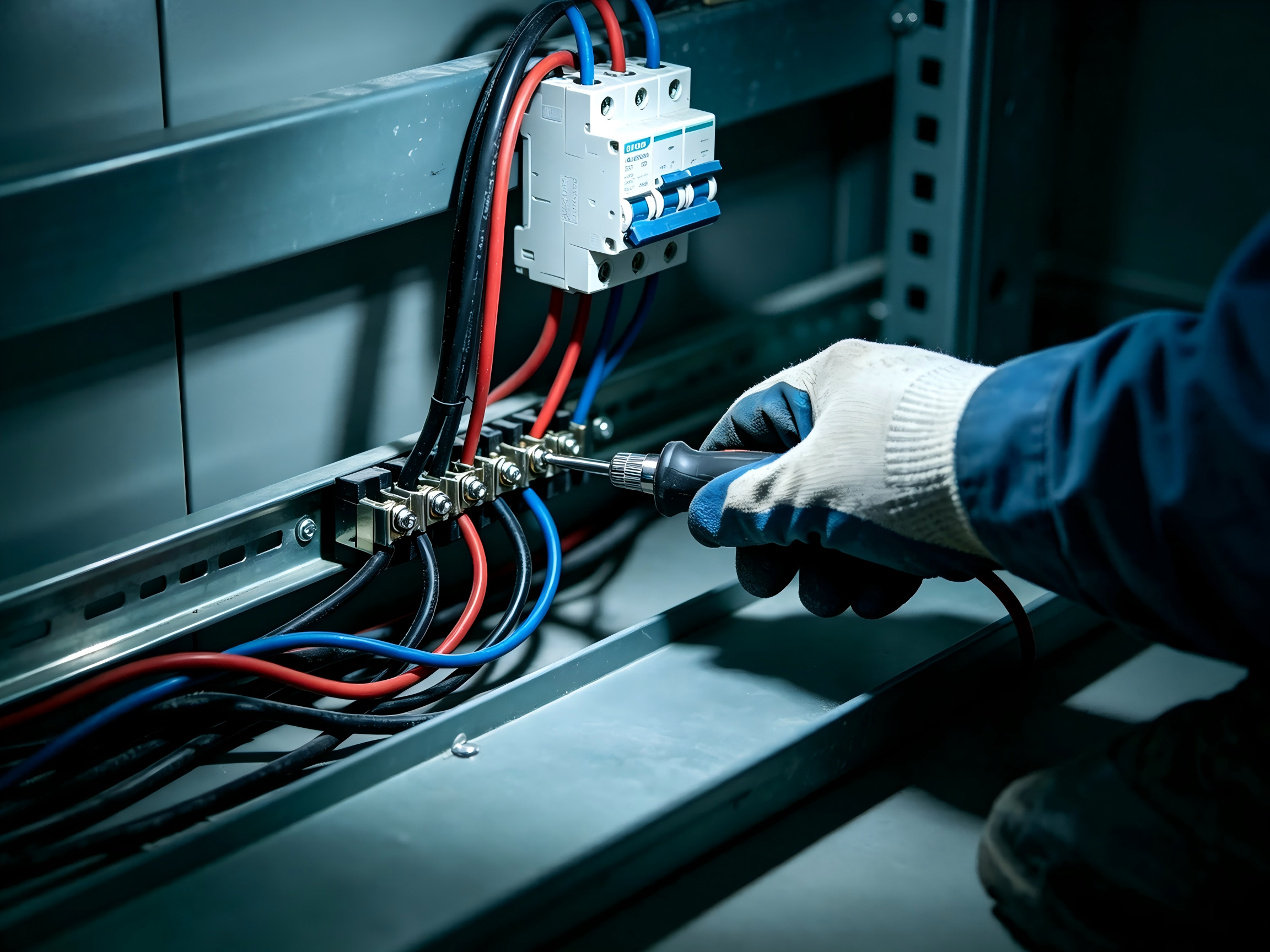
The Site Walk
I have learned not to start an installation survey by looking at the equipment.
I start with the wall socket.
Then I look at the water line, drain, room temperature, humidity, ventilation, and the route from the loading door to the final bench.
It is common to hear the same answer during a pre-installation visit:
“We have electricity. We have water. The room is ready.”
A few weeks later, the equipment may start showing intermittent alarms. A staining process becomes less consistent. A printer installation turns into a network discussion. Or the laboratory discovers that the available power circuit is shared with other equipment.
The equipment has not necessarily changed.
The installation conditions have.
That is why I treat the installation site as part of the equipment specification.
Why Power, Water, and Environment Matter
A tissue processor, identification printer, or automated staining and coverslipping system does not operate in isolation. It operates inside a building.
Power is the first example. Laboratory equipment can be sensitive to voltage fluctuations, brown-outs, black-outs, and surges. WHO procurement guidance says the facility infrastructure should be reviewed before procurement and recommends checking equipment sensitivity to these conditions because they may affect equipment life. WHO, Manual for procurement of diagnostics and related laboratory items and equipment
Water has a different effect. Histology processes use water for washing, rinsing, or reagent preparation, so water chemistry becomes part of the process. A 2003 study found that changing the water used in routine H&E washing changed stain colour intensity and differentiation. Interestingly, the result did not mean that more water treatment was automatically better: untreated tap water performed better than some softened or treated water in the study. Malkawi et al., Effect of water softening on the colour intensity of routine haematoxylin and eosin stain
Room conditions also matter. Temperature and humidity can affect reagent behaviour, wax handling, slide preparation, and equipment operation. The practical question is whether the room stays within the conditions required by the process and equipment.
This is why I prefer to think about laboratory infrastructure requirements before discussing capacity or features. The same logic applies to equipment installation site preparation.
Five Things I Check Before Installation
A useful site survey does not need to be complicated. It needs to happen before delivery and reflect realistic operating conditions.
| Check | What I look at | Practical point |
|---|---|---|
| Power | Voltage, fluctuation, circuit loading | Do not rely on one reading |
| Electrical protection | Grounding, phase arrangement, protection | Confirm the actual circuit |
| Water | Source, treatment, pressure and use | Test the water reaching the lab |
| Drainage | Drain location, capacity and waste route | Check before positioning equipment |
| Environment | Temperature and humidity | Record peak conditions |
1. Record the power, do not just measure it
A single voltage reading tells me what happened at that moment. It does not show what happens when another load starts, an air-conditioning system cycles, or the building changes between mains and backup power.
Power quality also has two practical sides: the normal supply level over time and short disturbances such as sags, surges, or interruptions. A short disturbance can happen between two perfectly normal meter readings.
Where practical, I prefer continuous observation.
The question is not simply, “Is the voltage correct?” It is, “How stable is the supply during normal laboratory operation?”
2. Check the actual electrical circuit
Grounding, phase arrangement, protection devices, and circuit loading should be confirmed with the facility's electrical team.
The equipment specification describes what the machine needs. The site survey determines whether the building can provide it.
3. Test the water that will actually be used
“Tap water is available” is not a water-quality assessment.
Depending on the process, check the source, treatment method, hardness, residual chemicals, suspended material, pressure, and whether the supply changes during the day.
For laboratory water quality in histology, the Malkawi study is useful because it prevents an oversimplified conclusion: changing water chemistry changed H&E results, but more treatment did not automatically produce better staining.
4. Follow the drain
Installation discussions often focus on the inlet and ignore the outlet.
The laboratory needs to know where liquid waste goes, whether the drainage route is accessible, and whether the planned equipment position creates a difficult connection.
WHO procurement guidance lists waste disposal and drainage among infrastructure considerations that should be addressed before procurement.
5. Measure the room at its worst
Measure temperature and humidity during the periods when the room is most heavily loaded.
A morning reading is not necessarily representative of the daily peak.
WHO procurement guidance treats environmental conditions as part of infrastructure planning and gives temperature-sensitive laboratory equipment and reagents as reasons to assess the facility before installation.
Three Ways to Deal With a Poor Installation Site
Not every laboratory can renovate the building. Budgets are limited, especially in older hospitals.
1. Modify the site
Install an appropriate electrical circuit, improve drainage, correct the water supply, or improve temperature and humidity control.
Best suited to: new laboratories, major renovations, or sites with long-term expansion plans.
Limitation: construction takes time and money and may not be practical in an existing hospital.
2. Add protection or treatment
Depending on the risk, this can include voltage regulation, surge protection, delayed protection, dedicated circuits, water treatment, or other utility conditioning.
WHO procurement guidance recognises regulators and surge protection as possible responses to power-quality risks and says equipment sensitivity to brown-outs, black-outs, and surges should be established.
Best suited to: existing laboratories where building modifications are difficult.
Limitation: an accessory can reduce a risk, but it does not make a fundamentally unsuitable site suitable.
3. Adapt the workflow
If infrastructure cannot be changed, the laboratory may adjust program timing, avoid starting several high-load devices simultaneously, change operating schedules, or use predictable off-peak periods.
Best suited to: intermittent problems that are operationally manageable.
Limitation: workflow adaptation adds discipline and should not conceal a serious infrastructure problem.
The right answer depends on the actual failure mode. There is no single infrastructure fix for every laboratory.
What This Means for Distributors and Laboratories
For distributors, site preparation should be part of technical qualification. A histology lab power supply should be treated as an installation input, not just a line in the equipment quote.
I would put these questions into the pre-sales checklist.
Site Survey Checklist
Electrical
- What is the measured supply voltage?
- Has the supply been observed over time rather than checked once?
- Which circuit will feed the equipment?
- Is it shared with other high-load equipment?
- What grounding and electrical protection are installed?
- Is there a generator or backup power system?
- How does the facility switch between normal and backup power?
Water
- What is the water source?
- Is it treated?
- Has the actual laboratory supply been tested?
- Is pressure stable during working hours?
- Which processes use the water?
Room
- What are the normal and peak temperature conditions?
- What are the normal and peak humidity conditions?
- Is condensation possible?
- Is ventilation adequate for the chemicals used?
- Is there enough clearance around the equipment?
Waste and installation
- Where does liquid waste go?
- Is the drain accessible?
- Can the equipment physically enter the room?
- Are doors, elevators, and corridors adequate?
- Are network connections available where required?
For tender documents, this has another value. A specification that only lists equipment functions can leave practical engineering questions until delivery.
A stronger specification can include a separate section for site requirements and engineering interfaces, covering electrical preparation, water and drainage, ventilation, network connection, positioning, transportation, commissioning, and acceptance testing.
This protects both sides. The laboratory knows what it must prepare, the distributor knows what it must supply, and the manufacturer knows what conditions must exist before commissioning.
That boundary matters in international projects because local building conditions can differ significantly from procurement assumptions.
When Equipment Design Helps
Infrastructure comes first, but equipment design can reduce some site-related interruptions.
For the conventional HT-AP-300 and HT-AP-600 tissue processors, the specified operating environment is 10–35°C and 30–85% relative humidity without condensation. Their specified electrical supply is approximately 220 V, 50 Hz, with power consumption below 2000 W.
The machines retain the current processing state during a short power interruption and can continue the program after power returns. This should not be confused with being unaffected by power failure.
Their gas collection and activated-carbon filtration design is a machine-level control, not a substitute for room ventilation.
Power planning should consider the total laboratory load, not one machine in isolation.
The same principle applies to identification equipment. The HT-SP1-UV slide printer measures 208 × 355 × 370 mm, weighs under 15 kg, and can mark an item in ≤3 seconds without ink or ribbon.
These are equipment facts. The remaining configuration and installation details should be checked against the product documentation rather than inferred from this article.
The Point Is Not to Blame the Building
A poor installation site does not automatically mean the laboratory made a mistake. Many laboratories operate in older hospitals where electrical circuits are shared, plumbing cannot be moved easily, and air-conditioning was designed for the building rather than a modern pathology workflow.
Some conditions can be corrected, some protected against, and some absorbed through workflow changes. Others should simply be identified before purchase.
That is the purpose of a site survey.
It is a way to separate an equipment problem from a building problem before both sides spend time troubleshooting the wrong thing.
Before choosing the machine, measure the room.
Before discussing performance, understand the utilities.
Before signing the installation plan, decide who is responsible for the site.
For distributors and tender agents, this is often the difference between delivering equipment and delivering a working installation.